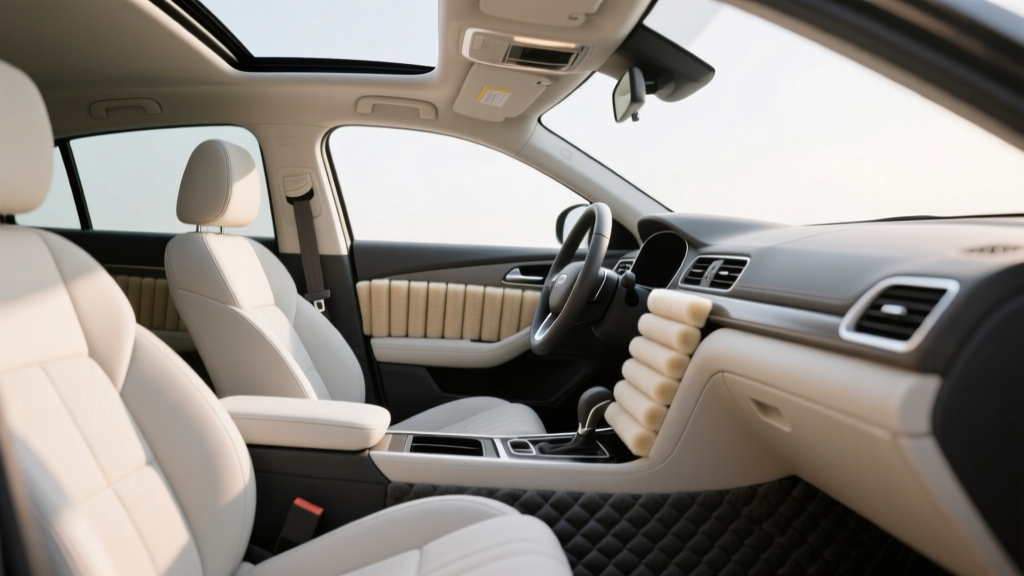
How to Soundproof Your Car Interior on a Budget: Complete DIY Guide
Road noise is the enemy of a comfortable driving experience. Whether you're trying to enjoy your car audio system, have phone conversations, or simply want a quieter commute, soundproofing your car interior can dramatically improve your daily drive. The best part? You can achieve professional-level results on a budget of $100-200.
Understanding Car Noise Sources
Car noise comes from three main sources: airborne noise (wind, exhaust), structure-borne noise (road vibration through the chassis), and impact noise (tire contact with road surface). Effective soundproofing addresses all three through a combination of mass loading, damping, and absorption.
Materials You'll Need
- Butyl rubber damping sheets (Kilmat or Noico, ~$40 for 36 sq ft) — replaces expensive Dynamat
- Closed-cell foam (~$25 for a 12-pack of 1" sheets) — blocks airborne noise
- Mass loaded vinyl (MLV) (~$30 per sheet) — adds mass to block low-frequency noise
- Weatherstripping (~$15) — seals door gaps
- Trim removal tools, utility knife, roller tool
Step 1: Door Panels (Biggest Impact)
Remove the door panel (usually 4-6 clips plus screws behind the handle and armrest). Clean the inner metal surface with isopropyl alcohol. Apply butyl damping sheets to cover 60-80% of the inner metal — you don't need 100% coverage for effective damping. Roll firmly to ensure adhesion. Add a layer of closed-cell foam over the damping material.
Step 2: Floor (Second Biggest Impact)
Remove seats (4 bolts each) and lift the carpet. Apply damping sheets to the exposed floor pan, focusing on areas near the exhaust tunnel and wheel wells. Add MLV for low-frequency blocking, then closed-cell foam for absorption. Reinstall carpet and seats.
Step 3: Trunk (Audio Enthusiasts)
The trunk acts as a resonance chamber. Line the trunk floor and rear deck with damping material. Pay special attention to the spare tire well, which is a major noise source. For audio upgrades, this is essential to prevent rattling and improve bass response.
Step 4: Hood (Engine Noise)
Apply a hood liner pad (or cut closed-cell foam to fit) to the underside of the hood. This absorbs engine noise before it enters the cabin. Use high-temperature adhesive — regular spray adhesive won't survive engine bay temperatures.
Step 5: Seal Gaps and Weatherstripping
Inspect all door, window, and trunk weatherstripping. Replace cracked or compressed seals. Add foam tape to any gaps where you can feel air movement at highway speeds. A $15 weatherstripping kit can eliminate wind noise that $200 in damping material can't fix.
Expected Results
A full treatment typically reduces interior noise by 3-8 dB depending on the vehicle. That might sound modest, but the human ear perceives a 3 dB reduction as noticeably quieter and 10 dB as half the volume. Most drivers report the biggest improvement in reduced fatigue on long drives and dramatically improved audio clarity.