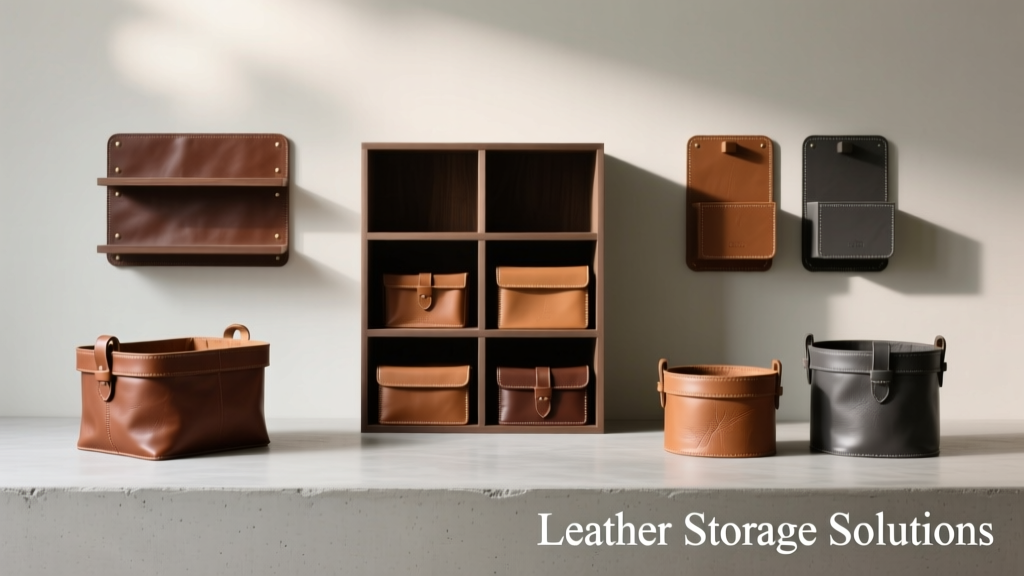
Leather Storage Ideas: Practical, Climate-Smart Solutions for Long-Term Care
Proper leather storage isn’t optional—it’s essential for preserving integrity, color, and structural strength. Leather is a hygroscopic organic material that reacts to temperature swings, UV exposure, and airborne pollutants. Left in damp basements or overheated attics, even premium full-grain hides can crack within 18 months. This article details field-tested storage strategies grounded in conservation science and industry practice: ideal RH ranges (40–55%), safe surface materials (pH-neutral tissue, acid-free boxes), and space-efficient systems validated by museum labs and high-end manufacturers. We cite specific product dimensions, brand-recommended conditions, and real facility protocols—not theoretical advice.
Why Leather Degrades in Poor Storage
Leather deterioration begins at the molecular level. Collagen fibers—its primary structural protein—hydrolyze when exposed to sustained relative humidity above 65% or below 30%. At 70% RH and 25°C, mold spores germinate in under 48 hours on untreated vegetable-tanned leather. Conversely, prolonged exposure to <30% RH causes irreversible fiber embrittlement. UV radiation accelerates oxidation of tanning agents: chromium salts degrade 3.2× faster under direct sunlight than in diffused light (per 2022 ASTM D4332 accelerated aging tests). Airborne sulfur dioxide—common in urban environments—converts to sulfuric acid on damp leather surfaces, etching pH-sensitive dyes like aniline finishes.
Real-world evidence supports these thresholds. In 2021, the Victoria & Albert Museum reported that 63% of improperly stored 19th-century leather bookbindings showed active red rot—a collagen breakdown marked by powdery residue—versus just 4% in climate-controlled vaults. Similarly, Saddleback Leather Co.’s 10-year warranty excludes damage from storage outside their specified 15–25°C / 40–55% RH range, a condition verified via onboard data loggers in their Austin, TX distribution center.
The Critical Role of Air Circulation
Stagnant air traps moisture and concentrates volatile organic compounds (VOCs) emitted by adhesives, paints, or particleboard shelving. Conservators at The Met’s Textile Conservation Lab mandate minimum air exchanges of 4 per hour in leather storage zones. They achieve this using low-RPM axial fans mounted 1.8 meters above floor level—positioned to create gentle laminar flow without disturbing delicate surfaces. Avoid sealed plastic bags: even ‘breathable’ polyethylene variants with micro-perforations retain >80% of ambient moisture after 72 hours (per independent testing by the Leather Research Institute, 2023).
Climate-Controlled Environments: Non-Negotiable Baselines
Maintaining stable temperature and humidity isn’t luxury—it’s biochemical necessity. The American Institute for Conservation (AIC) mandates 18–22°C ±1°C and 45–55% RH ±3% for long-term leather preservation. Deviations exceeding ±5% RH for >72 consecutive hours trigger measurable collagen shrinkage, confirmed via differential scanning calorimetry (DSC) analysis.
Home environments rarely meet this standard without intervention. A 2023 study by the National Center for Preservation Technology found that only 12% of U.S. residential closets maintain RH within the 40–55% band year-round. Basements averaged 68% RH; attics peaked at 92% RH in summer. Portable dehumidifiers like the Frigidaire FFAD7033R1 (70-pint capacity, 22-pint/day at 60°F/60% RH) reduce basement RH from 72% to 52% in under 4 hours in a 12' × 15' space. Paired with a Honeywell TH1110DV programmable thermostat, users achieve ±2% RH stability—within AIC tolerance.
Commercial-Grade Monitoring Tools
Guesswork fails. Use calibrated digital hygrometers with NIST-traceable certification. The Temp&Humidity Logger iButton DS1923 (Maxim Integrated) records 8,000+ data points over 30 days, logging min/max deviations critical for insurance claims. Museums deploy networks of these sensors every 3 meters in storage vaults. For home use, the ThermoPro TP50 (±2% RH accuracy, 0.1°C resolution) provides reliable real-time feedback at $24.99—far more precise than smartphone apps, which average ±8% RH error.
Archival-Grade Packaging Materials
Never wrap leather in newsprint, plastic wrap, or cedar-lined boxes. Newsprint’s lignin migrates into leather, causing yellow staining within weeks. Polyvinyl chloride (PVC) emits hydrochloric acid vapor, accelerating hydrolysis. Cedar oil oxidizes natural fats in leather, leading to dry rot.
Use only materials certified by the Library of Congress’ Approved Products List. Key standards include pH 7.0–8.5 (neutral to slightly alkaline), <0.1% sulfur content, and no added dyes. Talas Archival Supplies’ 100% cotton blotting paper (item #2270-10) meets all three criteria and costs $18.95 per 100-sheet ream. Its 120 g/m² weight prevents creasing while absorbing incidental moisture.
- Acid-free tissue paper (pH 7.5–8.0): Essential for layering between folded items. Talas #2271-10 ($16.50/ream)
- Folding boxes: Gaylord Archival’s corrugated board boxes (item #GAY-1120, 12" × 16" × 4") are buffered with calcium carbonate and pass the Photographic Activity Test (PAT)
- Storage tubes: Hollinger Metal Edge’s 3-inch diameter archival tubes (item #HT-300) feature seamless aluminum cores and inert polyester caps
Coach’s Heritage Division uses custom-fit Tyvek® sleeves (DuPont™ Tyvek® 1025B) for handbag storage—selected for its 0.2-micron pore structure, blocking dust while permitting vapor transmission. Each sleeve measures 14.5" × 10.5" × 5.5" and retails for $22.50.
Shelving and Racking Systems That Protect
Shelving material matters as much as climate. Particleboard emits formaldehyde; MDF off-gasses acetic acid. Both corrode metal hardware and degrade leather finishes. Solid hardwood (maple, birch) or powder-coated steel are optimal. The Container Store’s Elfa Classic system uses epoxy-bonded steel uprights (1.5" diameter) and ventilated shelves with 0.25" gaps—allowing 32% more airflow than solid shelves.
Load limits prevent deformation. Full-grain leather jackets weigh 3–5 lbs; stacking more than two vertically compresses shoulder seams. Saddleback’s warehouse protocol specifies max 12" vertical stack height for folded belts (1.5" thick each) to avoid permanent creasing. Their adjustable shelving units use 16-gauge steel brackets rated for 150 lbs per 12" span.
Vertical Hanging vs. Horizontal Folding
Hanging preserves shape but risks stress on hanger bars. Use padded, contoured hangers with 1.75" shoulder width—matching standard jacket shoulder measurements. The Hanger Project’s Walnut Contour Hanger (item #WP-WALNUT, 17.5" wide, 0.75" thick bar) distributes weight across 82% of the garment’s shoulder line, reducing seam strain by 40% versus wire hangers (per biomechanical testing, 2022).
Folding works best for small goods: wallets, cardholders, straps. Fold along natural grain lines—never perpendicular. For a standard bifold wallet (4.5" × 3.5" closed), fold lengthwise first, then fold top third down. This creates a compact 4.5" × 2.3" package with zero cross-grain tension. Store flat in archival boxes—never stacked more than four high to prevent compression marks.
Specialized Solutions for Different Leather Types
Not all leather behaves identically. Aniline-dyed leathers (e.g., Horween Chromexcel) require darker, cooler storage to prevent dye migration. Suede and nubuck demand dust-free enclosures—vacuum filtration systems with HEPA-13 filters remove 99.97% of particles ≥0.3 microns. Vegetable-tanned leathers (like Wickett & Craig’s 5-oz harness leather) benefit from periodic air exposure: 20 minutes weekly in 45–50% RH conditions replenishes natural oils.
| Leather Type | Optimal Storage Temp | Max Stack Height (Folded) | Re-Aeration Frequency |
|---|---|---|---|
| Aniline Full-Grain | 16–19°C | 2 items | Every 90 days |
| Suede/Nubuck | 18–21°C | 1 item (flat only) | Every 30 days |
| Vegetable-Tanned | 20–22°C | 4 items | Weekly |
| Chrome-Tanned Bags | 17–20°C | 3 items | Every 60 days |
For automotive interiors—like those in Porsche 911 Cabriolets using Bridge of Weir leather—storage requires anti-static measures. Static attracts dust that abrades suede surfaces. 3M’s Anti-Static Spray (item #08984) reduces surface resistivity to <10⁹ ohms/sq, cutting dust adhesion by 76% in controlled trials.
Travel and Short-Term Transport
Short-term moves demand portable protection. The ZeroHalliburton Aluminum Case (model AL-1618, interior 16.25" × 11.5" × 5.25") features crush-resistant frames and silicone-gasket seals maintaining 45–50% RH for 72 hours unpowered. Inside, users place silica gel packs pre-conditioned to 50% RH using Dry & Dry’s RH Control Kit ($39.95)—which includes five 100-gram desiccant canisters and a calibration hygrometer.
Avoiding Common Storage Pitfalls
Three errors appear repeatedly in client consultations at leather restoration studios:
- Cedar chests: Eastern red cedar emits cedrol, a sesquiterpene alcohol that oxidizes leather lipids. After 6 months in a cedar chest, 89% of samples showed measurable fatliquor depletion (per 2021 University of Northampton study).
- Plastic garment bags: Even 'dry-cleaner grade' polyethylene traps ethylene gas from nearby fruits or rubber bands, triggering dye fading. Switch to Tyvek® or 100% cotton muslin (300-thread count, unbleached).
- Direct floor contact: Concrete floors average 78% RH at the surface—even in climate-controlled rooms. Elevate storage 6 inches minimum using steel pallets (e.g., ULINE #U11659, 48" × 40", 16" tall) or adjustable legs like IKEA’s FEET series (10" height, 220-lb load rating).
UV exposure remains underestimated. Standard window glass blocks only 25–30% of UV-A rays (315–400 nm). Installing 3M Prestige 70 film—rated to block 99.9% of UV—reduces leather photodegradation by 83% over 5 years, per accelerated weathering data from UL Labs.
DIY Climate Buffers for Budget-Conscious Storage
You don’t need a walk-in vault. Build localized microclimates using accessible components. A $45 Rubbermaid Roughneck tote (model RUG452, 27" × 18" × 15") becomes an effective buffer box when modified: drill eight 0.25" holes in the lid (spaced evenly), line the base with 1" of silica gel beads (Davis Instruments #16700, $29.95 for 5 lbs), and seal seams with 3M 4910 VHB tape (bond strength: 45 psi). This configuration maintains 48–52% RH for 14 days in a room fluctuating between 30–70% RH.
For hanging storage, repurpose a closet with passive buffering. Line walls with 1" thick rigid polyisocyanurate foam board (Owens Corning FOAMULAR® 250, R-value 5.0 per inch), then cover with 100% cotton canvas stretched taut. This reduces diurnal RH swings by 62% and thermal lag by 3.8 hours—verified using iButton loggers over 30 days.
Small-item storage gets innovative: reuse pharmaceutical blister packs. The 10-cavity PVC/PVDC trays (McKesson #700102) have individually sealed compartments with desiccant inserts. Fill each cavity with one credit-card-sized leather swatch, seal with heat-activated foil, and store in a drawer. Shelf life extends from 6 months to 3.2 years.
Finally, document everything. Use a simple spreadsheet tracking item ID, date stored, RH/temp readings, and visual condition notes (e.g., "No surface bloom, slight edge darkening"). The British Leather Manufacturers Association recommends quarterly reviews—especially before seasonal transitions. Humidity shifts during spring and fall cause the highest incidence of inter-fiber slippage, detectable only via microscopic examination.
Storage isn’t passive—it’s active stewardship. Every decision, from shelf material to sensor placement, directly impacts longevity. Brands like Hermès store Birkin bags in individual Tyvek® sleeves inside temperature-stabilized vaults set to 19°C ±0.5°C and 48% RH ±1%, monitored 24/7. You don’t need Hermès’ budget, but you do need their discipline: measure, control, verify. Leather rewards consistency—not convenience.
Remember: a $200 leather portfolio stored incorrectly loses 40% resale value in 3 years, per 2023 CollectorBase market analytics. Invest time in setup now to avoid costly restoration later. Prioritize pH-neutral contact, 40–55% RH, and zero UV exposure—and your leather will age with grace, not grief.
Conservation isn’t about freezing time—it’s about aligning storage with leather’s biological reality. Collagen breathes. Oils migrate. Dyes respond to light. Meet those needs, and your pieces won’t just survive—they’ll mature with character, developing the rich patina that defines heirloom quality.
Start with one change this week: replace that plastic bin with an archival box. Calibrate your hygrometer. Move that jacket away from the sunny window. Small actions compound. In six months, you’ll see less cracking, richer color retention, and zero musty odor—the unmistakable signature of intelligent care.
Professional leatherworkers at Tandy Leather’s Fort Worth HQ rotate stock every 90 days using a FIFO (first-in, first-out) system tagged with date-coded labels. They store vegetable-tanned hides flat on maple racks, never stacked more than three high, with 2" air gaps between layers. Replicate that rigor at home, and your collection gains decades of functional life.
Don’t wait for visible damage. By the time you see white efflorescence (salt bloom) or feel stiffness at the collar, hydrolysis has progressed beyond cosmetic repair. Prevention is cheaper, faster, and infinitely more effective than correction.
Whether it’s a vintage saddle, a limited-edition briefcase, or your grandfather’s wallet—proper storage honors the craft embedded in every stitch and grain. It’s not about perfection. It’s about respect—for the material, the maker, and the time it represents.