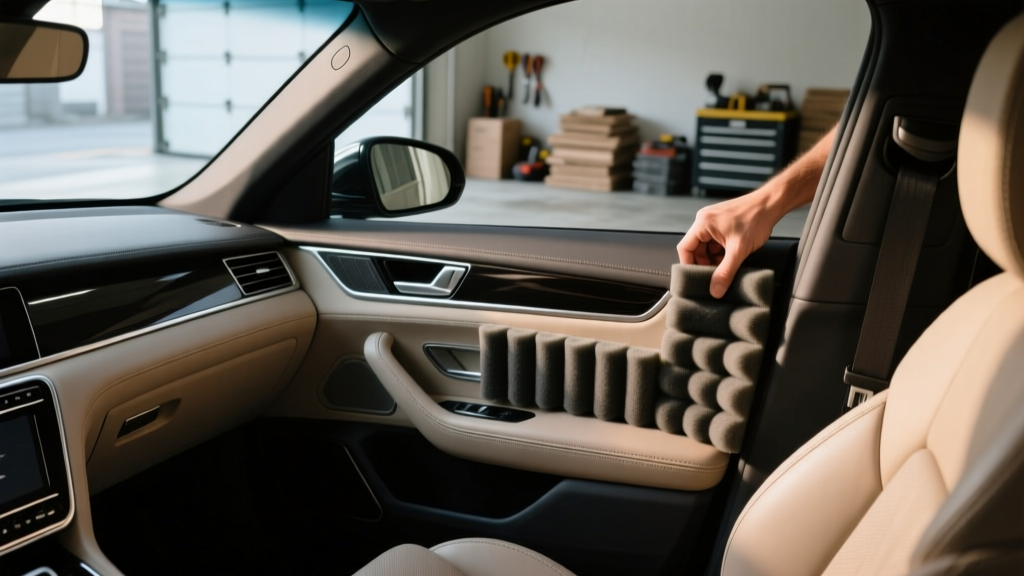
How to Soundproof Your Car Interior: DIY Guide for Quieter Rides
Why Cars Are Noisy
Car noise comes from three sources: road noise (tire contact with pavement), engine/drivetrain noise, and wind noise. Most factory sound deadening is minimal — manufacturers use thin sheets of asphalt-based material on door panels and floor to save weight and cost. Adding sound deadening material can reduce interior noise by 3-6 dB, which is perceptibly quieter.
Materials You Need
Butyl rubber sheets (CLD — Constrained Layer Damping): Dynamat Xtreme ($5/sqft), Kilmat ($2/sqft), or Noico ($1.50/sqft). These stick to metal panels and convert vibration energy to heat. You need about 25-40 sqft for a full car.
Closed-cell foam (CCF): A thin layer (1/8 inch) placed over the CLD material to decouple the panel from the interior trim. $0.50-1/sqft.
Mass-loaded vinyl (MLV): The heaviest and most effective layer. 1 lb/sqft MLV blocks airborne noise. Place on the floor under carpet. $2-3/sqft.
Step-by-Step: Doors (Highest Impact)
Step 1: Remove the door panel. Most doors have plastic clips and a few screws behind the armrest and handle.
Step 2: Remove the plastic moisture barrier (a thin sheet of plastic glued to the inner door frame). You will need to re-glue it later.
Step 3: Apply CLD material to the outer door skin (the metal panel facing outside). Cover 25-50% of the surface — full coverage is overkill and adds unnecessary weight.
Step 4: Apply CLD to the inner door frame as well, covering large access holes where possible.
Step 5: Replace moisture barrier, apply CCF over the inner door frame, reattach door panel.
Floor (Second Highest Impact)
Remove seats, carpet, and apply MLV + CCF to the floor pan. This is the most labor-intensive but most effective for road noise. Budget 4-6 hours.
Budget Alternative
If the full treatment is too expensive or labor-intensive, focus on the front doors only (about $30-50 in Kilmat material). This provides the most noticeable improvement per dollar spent.