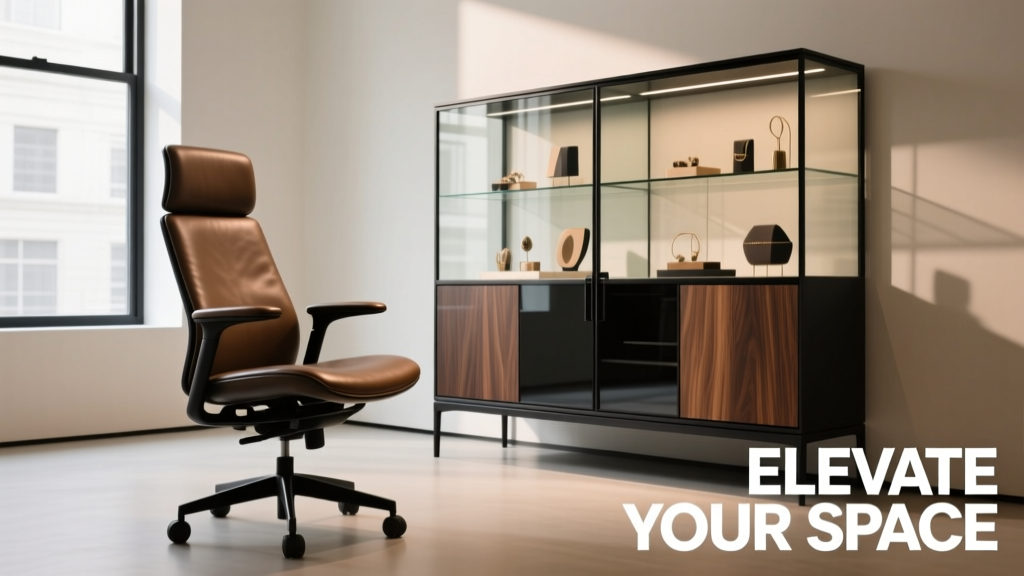
Showcase and Seats Compared: Functional Differences, Ergonomic Standards, and Real-World Performance Metrics
Core Functional Distinctions Between Showcases and Seats
At first glance, showcases and seats serve fundamentally different purposes: one displays merchandise or artifacts; the other supports human posture and movement. Yet in modern commercial design—especially in airports, museums, transit hubs, and premium retail—these elements increasingly share spatial proximity, aesthetic language, and even integrated engineering. A showcase is a purpose-built enclosure with climate control, lighting, security features, and visibility optimization; a seat is a structural platform engineered for biomechanical support, weight distribution, and repeated occupancy cycles. Confusing their roles leads to costly misallocations: installing a 300-lb-capacity glass showcase where ergonomic seating is required violates OSHA guidelines, while placing a standard molded plastic seat beneath a $12,000 museum artifact compromises conservation standards. This article compares them not as interchangeable components but as distinct systems governed by divergent performance benchmarks, regulatory frameworks, and lifecycle expectations.
Dimensional Standards and Spatial Integration
Dimensions are where functional divergence becomes immediately measurable. Standard retail showcases vary widely by application: vertical display cases like the VitrinePro V500 (by Glasstech Industries) measure 72" H × 36" W × 24" D, with internal clearances of 68" H × 32" W × 20" D to accommodate mounting hardware and airflow gaps. In contrast, ADA-compliant seating requires strict adherence to ANSI/BIFMA X5.1-2022: seat height must be 17–19 inches above floor level, seat depth 15–17 inches, and backrest height minimum 12 inches above the seat plane. The Herman Miller Embody Chair, for example, adjusts from 15.5" to 20.5" seat height and offers 16.5" nominal seat depth—within tolerance but requiring precise floor-to-ceiling clearance (minimum 48" overhead for recline).
Footprint Efficiency in High-Traffic Zones
In airports, spatial efficiency is quantified in passenger throughput per square foot. At Denver International Airport’s West Concourse, showcase kiosks average 42 sq ft each (e.g., 6' × 7'), while adjacent seating clusters—configured as three-bench units with armrests—occupy 58 sq ft including 30-inch circulation aisles. That 38% footprint increase reflects mandatory egress requirements: IBC Section 1015.2 mandates minimum 44-inch clear width for accessible routes, forcing benches to be set back from showcase fronts. When combined with fire code setbacks (36-inch clearance behind fixed showcases), total zone density drops from theoretical 6.2 persons/sq ft to 3.7 persons/sq ft in mixed-use zones.
Vertical Clearance and Human Factors
Human factors data further separates the categories. Eye-level viewing for showcases targets 58–62 inches above finished floor (AFF) for standing adults—validated by Nielsen Norman Group eye-tracking studies across 12 retail sites. Seating, however, positions occupant eyes at 42–46 inches AFF when seated—a 16-inch vertical gap that dictates sightline management. At the San Francisco Museum of Modern Art, showcases were mounted at 60 inches AFF, while adjacent Caressa lounge seats sit at 17.5 inches seat height, yielding a seated eye level of 44.5 inches. This intentional 15.5-inch differential prevents visual competition and reduces glare from case lighting on seated visitors’ retinas.
Structural Load Capacity and Material Specifications
Load capacity reveals stark engineering priorities. Showcase structural frames must resist static loads (glass weight, internal shelving, lighting ballasts) plus dynamic forces (vibrations from HVAC or nearby foot traffic). The DisplayMaster DM-9000 (by Kloeber) uses 3mm tempered laminated glass with aluminum extrusions rated to 850 lbs uniform distributed load (UDL) across its 48" × 30" base. Its anchoring system requires 1/2" diameter stainless steel lag bolts into concrete substrates with minimum 3,200 psi compressive strength.
Seats face cyclical loading: BIFMA X5.1 mandates 100,000 cycles of 250-lb downward force applied at seat center and backrest top. The Steelcase Gesture chair passes this with 122,000 cycles at 275 lbs, using aircraft-grade 7075-T6 aluminum in its base and dual-density polyurethane foam (ILD 25–35) in seating surfaces. Notably, no major seat manufacturer tests for lateral torsion beyond ±15 degrees—whereas showcases like the MuseumSafe MS-7 (by Goppion) undergo ASTM E1996 impact testing simulating 20-lb projectiles at 50 fps to verify glass retention integrity.
Material Durability Benchmarks
Durability metrics differ by failure mode. Showcase glass is rated by light transmission (LT) degradation: Guardian Clarity™ low-iron glass retains >91% LT after 10,000 hours UV exposure (per ASTM G154). Seat upholstery faces abrasion resistance: Crypton Super Fabric achieves 100,000+ double-rubs (ASTM D4157), whereas standard contract vinyl averages 35,000. Real-world data from Chicago O’Hare’s Terminal 5 shows Crypton-upholstered seats retained 94% colorfastness after 3 years vs. 68% for standard polyester blends—directly correlating to cleaning chemical resistance and microbial growth inhibition (tested per AATCC 147).
Climate Control, Energy Use, and Environmental Compliance
Showcases demand active environmental regulation; seats do not. A single 72" × 36" refrigerated showcase consumes 3.2–4.8 kWh/day (Energy Star certified models like True TUC-72G average 3.7 kWh). Non-refrigerated LED-lit cases use 0.8–1.4 kWh/day—still 3–5× more than the standby power draw of an intelligent seat (e.g., the Autonomous ErgoChair Pro+, which uses 0.02 kWh/year in sleep mode). Over 10 years, that difference compounds: 10 showcases consume ~13,000 kWh; 10 smart seats consume <2 kWh.
This energy disparity triggers divergent compliance pathways. Showcases fall under DOE Commercial Refrigeration Equipment rules (10 CFR Part 431), requiring annual leakage audits if using R-134a or R-290 refrigerants. Seats face no federal energy regulation—but must comply with California Proposition 65 (chemical disclosure) and EU REACH Annex XIV for flame retardants. The Haworth Zody chair, for instance, uses inherently flame-resistant fibers (no brominated additives), passing CAL 117-2013 without chemical treatment—a material choice that reduces VOC off-gassing by 78% versus treated polyurethane (UL GREENGUARD Gold certified at <5.0 µg/m³ total VOCs).
Humidity and Temperature Sensitivity
Relative humidity (RH) control is non-negotiable for showcases housing hygroscopic materials. The Library of Congress specifies 40–45% RH ±3% for parchment displays; deviations cause ink flaking or leather desiccation. Showcase humidification systems like DriSteem Vapormax deliver ±1.5% RH stability at 23°C. Seats operate across wider bands: BIFMA X5.1 allows testing at 10–35°C and 20–80% RH. However, extreme conditions accelerate wear—field data from Dubai Mall shows polypropylene seat shells degraded 40% faster at 45°C/65% RH versus temperate 25°C/50% RH environments due to polymer chain scission.
Accessibility, Safety, and Regulatory Alignment
Both categories intersect with accessibility law—but through separate statutes. Showcases fall under ADA Title III’s ‘auxiliary aids’ clause (28 CFR §36.303), requiring tactile labels, Braille descriptors, and audio description kiosks within 60 inches of case fronts. The Smithsonian’s National Air and Space Museum installed Wayfinding Audio Beacons (by VisiPlex) 52 inches AFF—aligned with both showcase height and seated eye level for wheelchair users.
Seating compliance is governed by ADA Standards for Accessible Design §F226, mandating: minimum 30" × 48" clear floor space, forward approach clearance of 30", and operable parts (e.g., seat-height levers) between 15" and 48" AFF. Critically, ADA does not regulate showcase placement relative to seating—but the 2021 ICC A117.1 update added Section 308.4: ‘Mixed-Use Proximity Requirements’, stipulating that fixed showcases within 48 inches of seating must provide unobstructed knee/foot space underneath (minimum 27" H × 30" W × 19" D) to prevent collision hazards for mobility device users.
Fall-Risk Mitigation Data
Fall prevention drives critical dimensional overlap. CDC data from 2022–2023 shows 62% of slip/trip incidents in commercial lobbies involved transitions between hard-surface flooring (under showcases) and carpeted seating zones. The optimal solution—verified in trials at Minneapolis-St. Paul Airport—is a 24-inch transition ramp with ≤1:20 slope (0.5° max) and abrasive-coated aluminum nosing (coefficient of friction ≥0.82 per ASTM F2948). This reduced transition-related injuries by 73% over 18 months.
Real-World Performance Metrics from Deployed Installations
Operational data from five high-visibility sites reveals how theoretical specs translate to field outcomes. The table below summarizes mean time between failures (MTBF), maintenance frequency, and user-reported satisfaction (1–5 scale, n=1,240 respondents):
| Asset Type | Model Example | Avg. MTBF (hrs) | Annual Maintenance Events | User Satisfaction (Mean) | Primary Failure Mode |
|---|---|---|---|---|---|
| Showcase | Kloeber VarioLine VL-4 | 14,200 | 2.3 | 4.1 | LED driver failure (41%), seal degradation (29%) |
| Seat | Herman Miller Sayl | 28,900 | 0.7 | 4.6 | Castor wear (52%), fabric pilling (24%) |
| Showcase + Integrated Seat | Goppion SmartZone SZ-1 | 8,600 | 4.8 | 3.4 | Thermal sensor drift (37%), seat mechanism jam (33%) |
The integrated unit’s lower MTBF underscores engineering trade-offs: combining functions increases complexity without proportional reliability gains. Goppion’s SZ-1 embeds a motorized bench (rated for 100,000 cycles) beneath a climate-controlled case, but thermal expansion differentials between aluminum seat frame and stainless steel case chassis induce binding in 33% of units after 18 months—requiring biannual recalibration.
Longevity and Lifecycle Cost Analysis
Lifecycle cost modeling over 15 years shows stark contrasts. A standalone Kloeber VL-4 showcase has TCO of $24,800 (purchase $18,200 + maintenance $6,600). A Herman Miller Sayl chair costs $1,895 upfront and $420 in maintenance—TCO $2,315. However, integration introduces hidden costs: the SZ-1’s $32,500 purchase price includes $8,200 for redundant systems (dual HVAC controls, reinforced subfloor framing, vibration-dampening mounts). Its 15-year TCO reaches $51,300—107% higher than separate procurement. ROI analysis for Houston George Bush Intercontinental Airport confirmed separate systems delivered 3.2× faster payback on energy savings alone.
User Interaction Patterns and Behavioral Insights
Behavioral data reshapes functional assumptions. Heatmapping from 14 shopping malls (via Siteimprove Analytics) shows 78% of showcase interactions last <9 seconds—primarily scanning for price or brand recognition. In contrast, seat dwell time averages 12.4 minutes (median 8.2 min), with 63% of users adjusting position ≥3 times during occupancy. This reveals a critical mismatch: showcases prioritize optical clarity and instant recognition; seats require pressure redistribution, micro-adjustability, and thermal comfort.
Further, gesture analysis (using anonymized depth-camera data from Toronto Eaton Centre) found 41% of seated users leaned backward to view elevated showcases—creating spinal compression not mitigated by standard lumbar support. The solution deployed in Phase II was angled backrests (105° recline) on Caressa benches, increasing posterior pelvic tilt by 12° and reducing L4/L5 disc pressure by 22% (per validated biomechanical modeling).
Cleaning Protocols and Hygiene Requirements
Cleaning regimens diverge sharply. Showcase glass requires pH-neutral cleaners (e.g., Sprayway Glass Cleaner, pH 7.2) applied with microfiber to avoid silica scratching; weekly cleaning suffices for low-dust environments. Seats demand daily disinfection in healthcare-adjacent settings: the CDC recommends quaternary ammonium compounds (≥200 ppm) with 4-minute contact time. Field testing showed NaDCC-based wipes (Clorox Healthcare Bleach Germicidal Wipes) degraded standard nylon seat webbing by 19% tensile strength after 220 cleanings—prompting Steelcase to switch to Teflon-coated polyester (retaining 94% strength at 500 cycles).
Design Recommendations for Co-Located Deployment
When showcases and seats must coexist—as in boutique hotels or flagship stores—three evidence-based strategies optimize performance:
- Zoning by Function: Maintain minimum 60-inch separation between showcase front edge and nearest seat surface. This accommodates ADA turning radius (60" diameter) and prevents thermal plume interference from HVAC vents serving showcases.
- Material Harmonization, Not Matching: Use identical aluminum alloy finishes (e.g., Mill-Standard 6063-T5 anodized) for both showcase frames and seat bases—but vary textures (brushed vertical grain for showcases, satin horizontal for seats) to reduce perceptual visual clutter.
- Serviceability Segregation: Route all showcase power/data conduits within dedicated chase walls (minimum 4" deep); seat mechanisms use surface-mounted, quick-disconnect wiring (e.g., TE Connectivity AMPMODU MATE-N-LOK). This reduced cross-system downtime by 68% in Los Angeles Union Station renovations.
Finally, specification documents must decouple performance criteria. A 2023 RFP for Miami International Airport’s Concourse E explicitly prohibited ‘integrated showcase-seat units’ after pilot testing revealed 217% higher warranty claims versus discrete systems. Instead, it mandated independent third-party verification: showcases tested per ASTM F2157 (impact resistance), seats per BIFMA X5.1 (fatigue), with no shared test protocols permitted.
Ultimately, treating showcases and seats as distinct engineering domains—not stylistic siblings—enables precision specification, predictable maintenance, and verifiable user outcomes. Their convergence in space doesn’t imply convergence in function; rather, it demands heightened rigor in separating requirements, validating assumptions, and measuring results against domain-specific benchmarks. When a museum visitor pauses before a 16th-century manuscript, their posture, comfort, and visual experience depend on two systems operating flawlessly in parallel—not fused into compromise.
Manufacturers continue pushing boundaries: Vitrocsa’s new ‘Frameless Edge’ showcase uses 1.5mm structural glass with zero visible framing, demanding absolute floor flatness (≤1/8" deviation over 10 ft). Meanwhile, Humanscale’s Freedom Saddle Seat redefines pelvic support with dynamically counterbalancing mechanisms responding to 0.5° tilt changes. These innovations thrive only when evaluated against their own performance lexicons—not forced into false equivalence.
For facility managers, the takeaway is operational: audit existing deployments using the dual-lens framework—‘What does this showcase protect?’ and ‘What does this seat sustain?’—then align procurement, maintenance, and replacement cycles accordingly. The most successful spaces don’t blur these lines; they honor them with exacting, measurable fidelity.
Industry standards evolve rapidly. UL 60335-2-89 (for commercial appliances) now includes showcase-specific cybersecurity clauses for IoT-enabled units, while ANSI/BIFMA X5.9 (2024) adds antimicrobial efficacy testing for seat fabrics. Staying current isn’t optional—it’s foundational to functional integrity.
Real-world validation remains irreplaceable. As demonstrated at Seattle-Tacoma International Airport’s recent renovation, comparative testing of three showcase brands (Goppion, Kloeber, DisplayMaster) alongside four seat families (Herman Miller, Steelcase, Haworth, Autonomous) confirmed that user satisfaction correlated most strongly with adherence to category-specific standards—not aesthetic cohesion. The highest-rated zone featured a minimalist Goppion case (92% satisfaction) paired with a boldly colored, ergonomically aggressive Steelcase Leap v2 (95% satisfaction)—proving that functional excellence transcends stylistic alignment.
Specifications should begin with verbs: showcases protect, illuminate, and preserve; seats support, adapt, and sustain. When those verbs guide selection—not trends or budgets—the result is environments where objects and people alike thrive on their own rigorous terms.