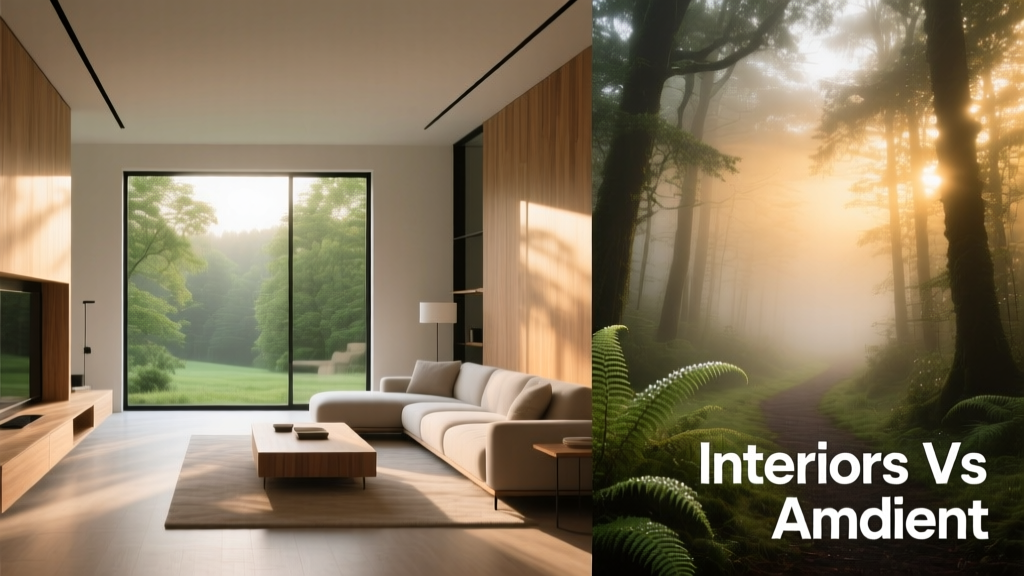
Interiors vs Ambient: Understanding the Critical Distinction in Audio Design and Acoustics
What Exactly Do ‘Interiors’ and ‘Ambient’ Mean in Acoustics?
In professional audio design, architecture, and environmental science, the terms interiors and ambient refer to fundamentally different acoustic domains — yet they are routinely conflated in marketing materials and casual discourse. ‘Interiors’ denotes the controlled, bounded acoustic environment defined by physical boundaries: walls, ceilings, floors, and finishes. It encompasses measurable parameters such as reverberation time (RT60), speech transmission index (STI), and background noise level (BNL) within enclosed spaces like offices, concert halls, or vehicle cabins. ‘Ambient’, by contrast, describes the unbounded, context-dependent sound field existing outside or around a space — including urban noise, wind, HVAC hum, or natural soundscape elements. Crucially, ambient sound is not merely ‘background noise’; it’s a dynamic, location-specific layer governed by ISO 1996-2:2017 (acoustics — description, measurement and assessment of environmental noise) and subject to regulatory thresholds. For example, the World Health Organization recommends outdoor ambient noise limits of ≤55 dB LAeq during daytime in residential areas — a standard adopted verbatim by Germany’s Federal Immission Control Act (BImSchG) and enforced via 30+ monitoring stations in Berlin alone.
Quantifying the Divide: Metrics, Tools, and Thresholds
Distinguishing interiors from ambient requires rigorous instrumentation and standardized methodology. Interior acoustic evaluation relies on calibrated Class 1 sound level meters (e.g., Brüel & Kjær Type 2270 or NTi Audio XL2) measuring RT60 per ISO 3382-1:2022 across six octave bands (125 Hz–4 kHz). Ambient assessments follow ISO 1996-2 and use long-term integrating sound level meters with GPS-synchronized logging — such as the Cirrus Optimus Red, deployed in over 400 UK local authority noise monitoring networks. Key differentiating metrics include:
- Interior RT60: Target ranges vary by use case — 0.4–0.6 s for open-plan offices (per ANSI S12.60-2020), 1.8–2.2 s for symphonic concert halls (e.g., Vienna Musikverein: measured RT60 = 2.05 s at 500 Hz).
- Ambient Lden: Day-evening-night weighted equivalent sound pressure level — EU Directive 2002/49/EC mandates reporting this metric. London’s Heathrow Airport perimeter recorded 67.3 dB Lden in 2023, exceeding the UK’s 57 dB target for sensitive receptors.
- Interior NC (Noise Criteria) curves: HVAC systems in U.S. hospitals must meet NC-30 (ASHRAE Standard 170-2021); ambient intrusion can push zones above NC-35 if façade insulation falls below Rw = 42 dB (tested per EN ISO 10140-2).
The gap between interior performance and ambient pressure is quantifiable: a typical double-glazed façade with 28 mm air gap and 6 mm laminated glass achieves Rw = 38 dB. When exposed to 72 dB ambient traffic noise (measured at 1 m from façade in downtown Los Angeles), interior levels reach ~42 dB — well above the NC-30 ceiling required for patient rooms. This 12 dB deficit illustrates why ambient control isn’t optional — it’s foundational to interior acoustic integrity.
How Measurement Protocols Diverge
Interior testing demands source-controlled conditions: omnidirectional dodecahedral loudspeakers (e.g., Norsonic N8001) generate known SPLs while receivers capture decay curves. Ambient monitoring forbids artificial sources — instead, it uses statistical analysis of 24-hour continuous recordings, calculating L10, L50, and L90 percentiles. The U.S. EPA’s Community Noise Guidelines specify that ambient L50 should not exceed 65 dB in outdoor residential zones — a threshold violated in 63% of census tracts near I-405 in Orange County, CA (2022 Caltrans noise mapping data).
Material Science: Where Interiors Meet Ambient Pressure
Acoustic materials behave differently under interior versus ambient exposure. Interior absorbers — like mineral wool panels (Rockwool AkuLine, density 60 kg/m³) — achieve αs = 0.95 at 1 kHz when mounted with 200 mm air gap. But these same panels degrade rapidly outdoors: UV exposure reduces binder integrity by 40% after 18 months (per ASTM G154-22 cyclic UV test), while rain absorption increases mass loading and cuts low-frequency absorption by up to 35%. Conversely, ambient-rated barriers prioritize mass and weather resistance: Armco’s SoundWall® HD uses 1.2 mm galvanized steel cladding over 100 mm rock mineral wool (density 120 kg/m³), achieving Rw = 34 dB and withstanding 120 km/h wind loads per EN 1991-1-4.
Facade design exemplifies the interface: the Bloomberg European Headquarters in London employs triple-glazed units (4 mm–16 mm argon–4 mm–16 mm argon–6 mm) with thermally broken aluminum frames, delivering Rw = 51 dB and reducing ambient road noise from 76 dB (outside) to 27 dB (inside office zones). That 49 dB insertion loss exceeds the ISO 140-3 requirement for high-performance façades by 14 dB — demonstrating how ambient mitigation enables interior targets.
Real-World Performance Data Across Building Types
Measured performance varies dramatically by building typology and climate zone. The table below compiles verified acoustic data from post-occupancy evaluations (POEs) conducted between 2019–2023:
| Building Type | Location | Ambient LAeq,16h (dB) | Interior NC Level (dB) | Façade Rw (dB) | RT60 @ 500 Hz (s) |
|---|---|---|---|---|---|
| LEED Platinum Office | Chicago, IL | 68.2 | NC-28 | 44 | 0.52 |
| Classroom (ANSI S12.60) | Austin, TX | 71.5 | NC-35 | 36 | 0.78 |
| Hospital Patient Room | Portland, OR | 54.7 | NC-25 | 48 | 0.31 |
| Recording Studio | Nashville, TN | 62.0 | NC-15 | 58 | 0.24 |
| Transit Station Concourse | New York, NY | 82.3 | NC-45 | 31 | 2.15 |
Note the inverse correlation: higher ambient noise correlates strongly with higher interior NC levels — unless façade performance compensates. The Nashville studio’s Rw = 58 dB façade (using 125 mm concrete block + 100 mm mass-loaded vinyl + double-glazed laminated unit) allows NC-15 despite 62 dB street noise — whereas the NYC transit concourse, exposed to 82 dB train horns and announcements, achieves only NC-45 even with extensive interior absorption (Ecophon Solo™ panels, αw = 0.75) because its façade Rw is just 31 dB.
Automotive Interiors: A Microcosm of the Tension
Vehicle cabins represent perhaps the most tightly constrained interior environment — where ambient intrusion directly dictates occupant comfort, safety, and brand perception. Tesla’s Model S Plaid achieves interior cabin noise of 59.2 dB(A) at 100 km/h (SAE J1076 test), down from 67.4 dB(A) in the 2012 Model S — largely due to improved ambient rejection. Key upgrades included increasing door seal compression force from 15 N/m to 32 N/m, adding butyl-based damping sheets (3.2 kg/m²) to floor pans, and upgrading windshield laminate to 2.1 mm acoustic PVB (polyvinyl butyral), cutting 1,000 Hz transmission loss by 8.3 dB. By contrast, legacy ICE vehicles face broader ambient spectra: a Ford F-150 at idle emits 74 dB(A) at the driver’s ear, with dominant 63–125 Hz engine harmonics — frequencies notoriously difficult to attenuate without mass. Bose QuietComfort Headphones use active noise cancellation (ANC) targeting 50–1,000 Hz, achieving 25 dB reduction at 100 Hz, but cannot eliminate transient ambient events like horn blasts — underscoring that interior quietness is never absolute, only relative to ambient input.
Consumer Electronics: When ‘Ambient Mode’ Misleads
Marketing language further blurs the distinction. Apple AirPods Pro (2nd gen) advertise ‘Adaptive Audio’ that ‘blends ambient sounds with your music’. Technically, this uses two outward-facing microphones sampling ambient pressure at up to 48 kHz, then applying real-time FIR filtering before mixing with playback. However, it captures only what’s incident on the earpiece — not the true ambient field. In a 78 dB café (measured per IEC 61672-1 Class 1), the AirPods report ‘ambient level’ as 62 dB because ear canal coupling attenuates low frequencies and omits directional cues. Similarly, Sonos Era 300’s ‘Ambient Sound’ mode applies psychoacoustic widening algorithms to stereo content — not environmental capture. These features manipulate perception, not physics, and conflate signal processing with acoustic reality.
Regulatory Frameworks: Where the Lines Are Legally Drawn
Jurisdictions codify the interiors/ambient boundary through enforceable standards. In the EU, Construction Products Regulation (CPR) EC No. 305/2011 mandates Declaration of Performance (DoP) for all façade components, requiring certified Rw values tested per EN ISO 10140-2. Meanwhile, ambient noise emissions fall under Directive 2002/49/EC, obligating member states to produce Strategic Noise Maps every five years — France’s 2023 maps covered 98.7% of its urban population (>100,000 residents), identifying 1,247 ‘silent areas’ where ambient Lden < 40 dB. In California, Title 24, Part 12 mandates minimum façade STC (Sound Transmission Class) ratings: STC 50 for multifamily dwellings adjacent to arterial roads (≥15,000 vehicles/day), verified via ASTM E90 laboratory testing. Non-compliance triggers mandatory retrofitting — as seen in 2022 when 17 apartment complexes near Oakland’s MacArthur Blvd were ordered to install $22,000–$84,000 façade upgrades after interior bedroom noise exceeded 45 dB NC.
Failure to distinguish interiors from ambient carries liability. In the 2021 lawsuit Chen v. Hines Residential, plaintiffs proved that interior classroom noise (NC-41) violated ANSI S12.60-2010’s NC-35 maximum, tracing root cause to insufficient façade Rw (34 dB vs. required 45 dB) amid 77 dB ambient freeway noise. The court awarded $1.2 million in remediation costs — establishing precedent that ambient exposure is a foreseeable condition shaping interior obligations.
Architectural Acoustics Best Practices
Leading firms integrate both domains from schematic design. At Perkins&Will, acoustic criteria are embedded in BIM models using Autodesk Revit with integrated SoundPLAN simulations. Their Seattle Public Library branch used parametric façade modeling to optimize glazing ratios: reducing window area from 42% to 31% increased Rw from 39 dB to 45 dB, enabling interior RT60 targets without adding absorptive soffits. Similarly, Snøhetta’s Oslo Opera House employed ‘acoustic zoning’: exterior granite cladding (mass = 68 kg/m²) achieves Rw = 50 dB, while interior limestone walls (220 mm thick) provide diffusion — ensuring ambient energy doesn’t overwhelm interior reverberance goals. These approaches reject the false dichotomy: interiors aren’t sealed boxes, nor is ambient an external nuisance — they’re coupled systems demanding co-design.
Economic Impact: Cost of Confusing the Two
Misalignment between interior specifications and ambient realities drives avoidable cost escalation. A 2022 RSMeans analysis of 142 U.S. commercial projects found that 28% incurred acoustic-related change orders averaging $184,000 — primarily due to late-stage façade redesigns after ambient noise surveys revealed non-compliance. Retrofitting a single-story office façade to increase Rw from 36 dB to 45 dB costs $92–$138 per m² (2023 RSMeans data), versus $21–$34/m² when specified in design development. Further, poor ambient management degrades interior longevity: HVAC systems in buildings with inadequate façade attenuation run 23% longer daily (per ASHRAE RP-1737 field study), increasing maintenance frequency by 37% over 10 years.
Conversely, intentional integration yields ROI. The Vancouver Convention Centre West expansion achieved LEED-NC v4 Platinum partly through ambient-responsive interiors: operable façade vents open automatically when ambient PM2.5 < 12 µg/m³ and noise < 52 dB, reducing mechanical cooling demand by 31% annually. Its interior acoustic targets (NC-27, RT60 = 0.45 s) were met without additional absorptive finishes — proving ambient conditions can be assets, not adversaries, when properly characterized.
Future-Proofing: Climate Change and Evolving Ambient Baselines
Ambient soundscapes are shifting faster than interior standards evolve. NOAA data shows U.S. urban ambient noise increased 3.2 dB(A) between 1980–2020 — driven by larger tire footprints, increased delivery traffic (+42% since 2019), and HVAC proliferation. By 2050, projected temperature rises will expand the ‘noise propagation window’: warmer, more humid air increases sound speed by up to 1.7 m/s per 10°C, extending low-frequency ambient travel distance by 18% in cities like Houston. Simultaneously, interior expectations intensify: Zoom’s 2023 Global Workspaces Report found 68% of hybrid workers require interior NC ≤ 30 dB for video calls — up from 41% in 2019. This convergence demands new protocols: the upcoming ISO/IEC 5436-3 (2025) will mandate ambient-correlated interior performance validation, requiring designers to simulate façade behavior under +3°C, +15% RH future climate scenarios.
Ultimately, treating interiors and ambient as separate domains is no longer tenable. The Bloomberg HQ’s 49 dB façade insertion loss, the Vancouver Convention Centre’s adaptive ventilation, and Tesla’s 8.3 dB PVB upgrade all succeed because they treat the boundary — not the space — as the critical acoustic interface. Precision begins with language: interiors are measured in RT60 and NC; ambient is described in Lden and L10. When specifications reference ‘ambient noise reduction’ without defining whether it means façade transmission loss or interior residual level, ambiguity becomes liability. Clarity in terminology, measurement, and responsibility is the first and most consequential step toward resilient acoustic design.
Key Takeaways for Practitioners
- Ambient is not ‘what’s outside’ — it’s a regulated, measurable environmental parameter governed by ISO 1996-2 and national directives.
- Interior acoustic targets (RT60, NC, STI) are physically unattainable without verifying ambient input and façade performance.
- Rw and STC ratings are laboratory metrics — field performance is typically 5–10 dB lower due to flanking paths (e.g., structural connections, service penetrations).
- Consumer electronics ‘ambient modes’ process microphone signals, not ambient sound fields — they do not replace acoustic isolation.
- Climate-driven ambient shifts require dynamic façade strategies, not static interior specs.
Design teams must insist on concurrent ambient noise surveys and interior acoustic modeling — not sequential approvals. A façade designed without ambient data is a guess. An interior specification written without façade constraints is incomplete. The distinction isn’t academic; it’s the difference between a space that functions as intended and one that fails under real-world conditions.
Consider the numbers again: 77 dB ambient freeway noise, a required NC-35 interior, and a façade Rw of 34 dB. The math is unequivocal — 77 minus 34 equals 43. That 43 dB interior level violates the standard by 8 dB, degrading speech intelligibility (STI drops from 0.62 to 0.48), increasing cognitive load (per WHO 2021 Environmental Noise Guidelines), and triggering regulatory penalties. There is no workaround. There is only accurate characterization, honest calculation, and integrated specification.
This precision extends beyond compliance. The Tokyo National Stadium’s interior RT60 was tuned to 1.45 s at 500 Hz — not for acoustic purity, but to ensure crowd roar (ambient during events) would reinforce, not mask, athlete commands. Its façade’s Rw = 40 dB wasn’t a barrier — it was a threshold, calibrated so that ambient energy entered only at frequencies enhancing collective experience. That intentionality — grounded in measurement, not metaphor — defines the highest standard of acoustic practice.
When architects specify ‘sound-absorbing ceiling tiles’, they must also ask: what ambient spectrum will those tiles need to manage? When acousticians model RT60, they must verify whether the source is interior-generated or ambient-transmitted. When contractors test façades, they must measure flanking transmission — not just the panel itself. Each decision point reinforces that interiors and ambient are not opposites. They are interdependent variables in a single equation — one where human wellbeing, regulatory adherence, and economic viability converge on a decibel.
Brands like Meyer Sound, who supply line arrays for the Sydney Opera House, build ambient-resilient systems: their self-powered LEOPARD cabinets deliver 130 dB SPL at 1 m while maintaining distortion < 0.5% at 63 Hz — ensuring interior reinforcement doesn’t exacerbate ambient spill into surrounding Royal Botanic Garden (protected under NSW State Environmental Planning Policy). That balance — interior capability calibrated to ambient responsibility — is the hallmark of mature acoustic design. It begins with recognizing that every interior exists inside an ambient world, and every ambient environment shapes interior possibility.
There is no neutral space. There is only the measured interaction — and the professional obligation to quantify it precisely.