How to Install LED Interior Lights in Your Car: Complete Guide
LED interior lights transform your car's cabin from dim and dated to bright and modern. They use 80% less power than halogen bulbs, last 10x longer, produce more light, and are available in various colors. Most interior LED upgrades take 15-30 minutes with no special tools. Here is everything you need to know.
Identifying Your Bulb Types
Before ordering LEDs, identify the bulb types your car uses. The most common interior bulb types are: DE3175 (festoon, 31mm) — used in dome lights and map lights in many Japanese and Korean cars. 194/T10 (wedge base) — used in dome lights, trunk lights, and license plate lights in many American and European cars. 168/T10 — same physical size as 194 but lower wattage. Check your owner's manual, remove the existing bulb and read the number printed on the base, or use an online bulb finder tool (Philips and Sylvania both offer these on their websites).
Choosing LED Bulbs
LED bulbs come in several configurations. Canbus error-free bulbs have built-in resistors that prevent the car's computer from detecting a bulb-out error (needed in most European cars). Non-canbus bulbs are cheaper but may trigger dashboard warnings in newer vehicles. Color temperature options: 3000K (warm white), 4000K (neutral white), 5000K-6000K (cool white, most popular), and 8000K+ (blue-white). For interior use, 5000K-6000K provides the best visibility and a clean, modern look. Avoid colored LEDs (red, blue, green) for dome and map lights — they reduce visibility and may be illegal in some jurisdictions for lights visible from outside.
Installation: Dome Light
Pry off the dome light lens cover using a flat plastic trim tool (not a screwdriver — it will crack the lens). Most covers have small notches for prying. Remove the old bulb by pulling it straight out (wedge base) or pushing to one side (festoon). Insert the LED bulb — note that LEDs are polarity-sensitive, so if it does not light up, flip it 180 degrees. Test before replacing the lens. Some LED festoon bulbs are longer than stock — check that they fit between the contact points without bending. Replace the lens cover.
Installation: Map Lights and Visor Lights
Map lights follow the same procedure as dome lights. Visor vanity lights may require removing the visor mirror cover (usually clips or small screws). These bulbs are typically very small (T5 or festoon 28mm) — handle carefully as the LED modules are fragile.
Installation: Trunk and Glove Box Lights
Trunk lights are usually accessible without any disassembly — just pull out the old bulb and push in the new one. Glove box lights may require reaching behind the glove box door. Both are typically 194/T10 wedge bulbs.
LED Strip Lights (Optional Accent Lighting)
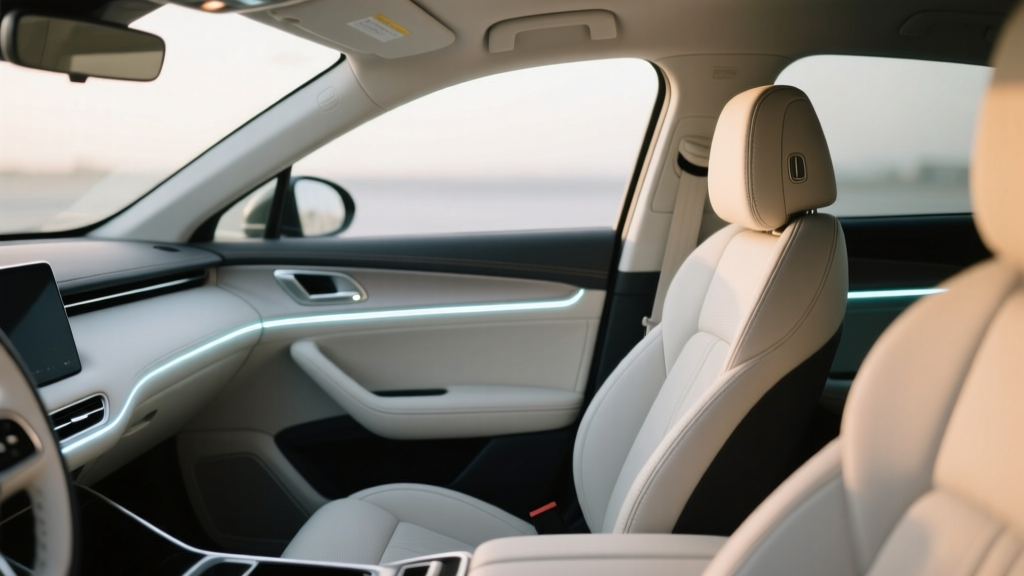
For ambient accent lighting, LED strip lights can be installed under the dashboard, in footwells, or along door sills. These kits ($15-30) include adhesive-backed LED strips, a controller, and a 12V power adapter that plugs into the cigarette lighter. For a cleaner install, connect directly to a fuse box circuit using an add-a-fuse tap. Choose strips with a remote control for color and brightness adjustment.
Legal Considerations
Most states allow any color for interior lights as long as they are not visible from outside the vehicle while driving. Red and blue interior lights visible from outside can result in a ticket (they mimic emergency vehicles). Check your local regulations before installing colored accent lighting. White and amber interior lights are generally legal everywhere.