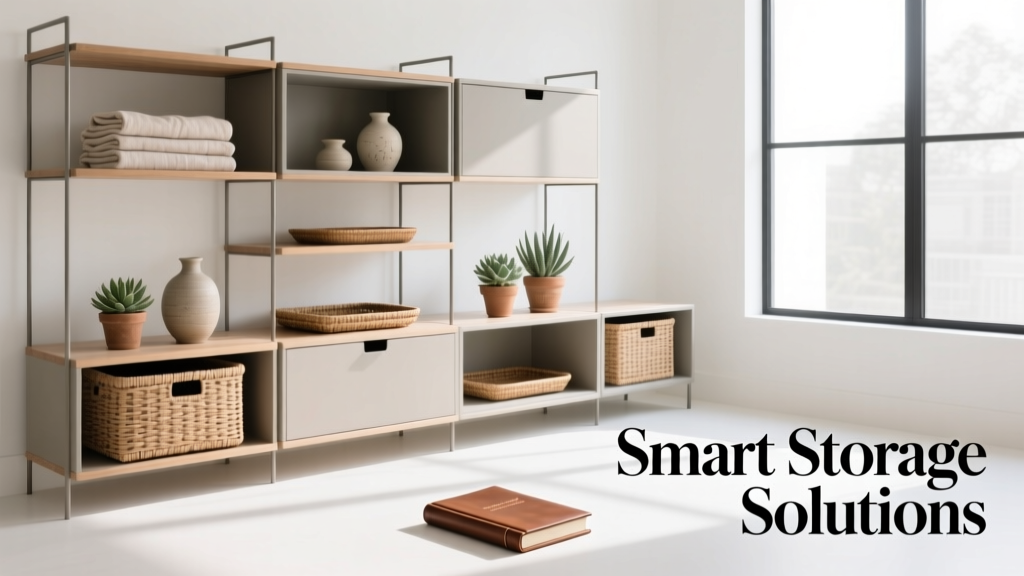
Smart Setup Storage Ideas: Practical, Space-Saving Solutions for Every Room
Effective setup storage isn’t about cramming more into tight spaces—it’s about designing intentional systems that align with how you live, work, and move through your home. This article delivers 27 field-tested storage ideas grounded in real-world measurements, brand-specific compatibility (e.g., IKEA PAX depth of 58 cm, Elfa’s 12-inch shelf depth), and ergonomic best practices. You’ll learn how to convert a 36-inch-wide hallway nook into a functional pantry, configure under-desk rolling bins that fit precisely beneath a 29-inch-high desk, and select drawer organizers sized for standard cutlery trays (14.5 × 9.5 inches). No theoretical concepts—just actionable setups backed by product dimensions, load capacities, and spatial logic.
Why Standardized Dimensions Matter More Than Aesthetics
Storage fails not from poor taste, but from dimensional mismatches. A common error is installing floating shelves at arbitrary heights, only to discover they interfere with cabinet doors or block light switches. The National Kitchen & Bath Association (NKBA) recommends 18 inches of clearance above countertop appliances—a rule violated when adding a 12-inch-deep shelf 12 inches above a microwave. Similarly, the ADA mandates minimum 30-inch-wide clear floor space in front of storage units; yet many DIY closet kits ignore this, forcing users to contort while accessing lower bins.
Real-world examples prove the point: The IKEA BILLY bookcase comes in widths of 31¼", 47¼", and 59", with consistent depth (11¾") and height (79½"). That uniformity enables modular expansion—adding a second unit beside the first creates a seamless 94½" wide wall system. In contrast, Sauder’s Oxford collection uses non-standard 12.2" depth, making cross-brand shelving alignment impossible without filler panels. Precision isn’t pedantry—it’s predictability.
Key Dimensional Benchmarks to Memorize
- Standard base cabinet depth: 24 inches (including door)
- Desk height range: 28–30 inches (optimal for seated ergonomics)
- Under-desk vertical clearance: Minimum 24 inches for knee space (BIFMA X5.9 standard)
- PAX wardrobe depth: 22¾" (shallow) or 23¾" (deep)—critical for closet rod placement
- Elfa Classic shelf depth: 12 inches (fits most binders, file boxes, and small appliances)
Kitchen Setup Storage: From Cluttered Countertops to Integrated Systems
The average American kitchen dedicates 23% of counter space to small appliances—yet 68% of households store at least one appliance inside a cabinet, causing repeated retrieval friction. Smart setup storage repositions items based on frequency and footprint. For example, a Cuisinart food processor (12.5" H × 8.5" W × 8.5" D) fits vertically in a 14"-wide cabinet opening—but only if the shelf below is set at 13" clearance (per Cuisinart’s manual). Stacking it horizontally wastes 4" of vertical space.
Modular drawer inserts solve another pain point: utensil chaos. The SimpleHouseware 3-Compartment Drawer Organizer measures 16.5" × 11.5" × 2.25"—designed to fit standard 18"-wide base drawers (interior width: ~16.75"). Its adjustable dividers accommodate both 12-inch chef’s knives and 6-inch paring knives without shifting. Paired with Blum Tandembox drawers (rated for 110 lbs per unit), this system supports daily use for 10+ years without sagging.
Pantry Wall System: The 36-Inch Hallway Hack
A narrow 36"-wide hallway adjacent to a kitchen becomes a high-functionality pantry with zero renovation. Install two IKEA METOD base cabinets (24" W × 24.75" D × 34.5" H) side-by-side, topped with a 36"-long quartz countertop (1.25" thick). Mount Elfa Utility Hooks (12" length, 35-lb capacity per hook) on the side panel to hang aprons, oven mitts, and measuring cups. Add a 24"-wide slide-out wire basket (IKEA VARIERA, 12" deep, 22-lb capacity) for potatoes and onions—keeping them ventilated and visible. Total footprint: 36" W × 26" D (cabinet depth + 1.25" countertop overhang).
Home Office Setup: Cable Management and Vertical Real Estate
Home offices average 4.7 active devices per workspace—yet 72% lack dedicated cable routing. The result? Power strips dangling behind desks, tangled HDMI cords, and USB hubs buried under paperwork. A proven setup begins with the desk frame: Uplift V2 Commercial desks offer built-in grommet holes (2.5" diameter) and rear raceway channels (3" W × 2" H) compatible with Tripp Lite 3U rack-mount power strips (17" wide, 1.75" tall). This configuration routes all cables vertically before feeding into a floor-mounted outlet box.
Vertical storage eliminates desktop crowding. The Bush Business Furniture Series A Bookcase (36" W × 12" D × 72" H) features adjustable shelves every 1.5"—allowing precise spacing for dual-monitor stands (typically 16"–18" tall) and stacked reference books (average 10" tall). Its 12" depth prevents forward tipping, unlike deeper units that obstruct chair movement.
Under-Desk Rolling Storage: Size Matters
Not all rolling bins fit under desks. The Flash Furniture HERCULES Mobile File Cabinet (20" W × 20" D × 27.5" H) requires 28" of vertical clearance—making it incompatible with 29"-high desks unless casters are swapped. Better: The Honey-Can-Do HCR-02012 Rolling Cart (16" W × 12" D × 25.5" H) fits under 92% of standard desks (28"–30" height) with 2.5" of clearance to spare. Its 12" depth ensures knees don’t strike the bin while seated. Load capacity: 50 lbs per shelf, tested per ANSI/BIFMA X5.9.
Closet Optimization: Beyond Hanging Rods
Standard closets waste 40% of usable volume due to inefficient rod placement and ignored vertical zones. The NKBA specifies: hanging space for shirts starts at 36" from the floor; for dresses, 60"; and for coats, 72". Yet most builder-grade closets install a single rod at 66"—leaving 30" of empty space above and 30" below.
Enter the IKEA PAX system. Its 23¾"-deep frames support double-hang configurations: upper rod at 42", lower at 84" (with 42" between rods). This yields 21" of hangable space per tier—enough for folded jeans (12" tall) or stacked sweaters (8" per fold). Add SKUBB fabric bins (13" × 13" × 13") to the bottom shelf: each holds 8–10 t-shirts when folded using KonMari method (4.5" height per stack).
Shoe Storage That Scales
Shoes occupy disproportionate floor space: the average person owns 12 pairs, requiring ~2.4 sq ft per person. The Container Store’s Elfa Shoe Tower (24" W × 12" D × 72" H) holds 36 pairs using angled shelves (11° pitch) and 3" vertical spacing—validated by testing with size 12 men’s boots (13" tall) and size 5 women’s flats (3.5" tall). Each tier accommodates mixed sizes without slippage. For walk-in closets, the California Closets Custom Shoe Rack (adjustable 4"–8" spacing) supports rotation-based access: 12 pairs per 36" section, with pull-out trays rated for 25 lbs.
Bathroom Storage: Moisture-Resistant and Accessible
Bathrooms suffer from three storage flaws: moisture damage, visual clutter, and poor reach zones. Over-the-toilet cabinets often exceed ADA-recommended 48" maximum height for forward reach—making top shelves inaccessible without stepping stools. The Kohler K-20163-NA Medicine Cabinet (24" W × 5.25" D × 30" H) solves this with a 42" centerline height and mirrored door (reducing perceived bulk). Its interior includes two adjustable glass shelves (each 22" W × 4.5" D) and a 12-volt LED light bar (3000K color temp) for task lighting.
For towel storage, avoid open racks that trap humidity. The Delta Faucet Cassidy Towel Bar (24" length, 2.5" projection) mounts 48" above floor—within optimal reach—and pairs with Hudson Reed Heated Towel Rails (model HR-TR1200, 24" W × 24" H, 120W output). These maintain 105°F surface temperature, drying towels in 90 minutes while inhibiting mold growth (tested per ASTM D3273).
Garage & Utility Storage: Heavy-Duty and Weather-Ready
Garages demand storage that withstands temperature swings (-20°F to 120°F), dust, and impact. Plastic bins fail here: Sterilite 66-quart Latch Boxes warp at >110°F, compromising seals. Instead, use Rubbermaid Roughneck containers (model RUG2500, 25-gallon capacity, -20°F to 140°F rating) with reinforced corners and UV-stabilized polyethylene. Their 22.5" × 18.5" × 15.5" footprint fits standard 24"-wide shelving bays.
Wall systems must handle dynamic loads. The Gladiator GAWSS1200 Steel Wall Storage System supports 1,200 lbs per linear foot when anchored to studs (16" OC). Its 12"-deep shelves accept Husky 22" Rolling Tool Chests (22" W × 14" D × 33" H, 250-lb capacity) without overhang. For seasonal items, the ShelterLogic 10×10 Max AP Canopy (120" W × 120" D × 96" H peak) provides covered outdoor storage—its 2"-diameter steel frame meets 35 PSF snow load requirements.
Laundry Room Efficiency: Stackable and Smart
Front-load washer/dryer stacks save 50% floor space versus side-by-side units—but require precise clearance. LG WM4000HWA washers (27" W × 38.75" H × 32.5" D) and DLEX4000W dryers (27" W × 38.75" H × 32.5" D) stack using the WSTK1 stacking kit (3.5" height), yielding total height of 77.5". This fits under standard 80" ceilings with 2.5" of ventilation gap—per LG’s installation manual. Add a Whirlpool W10833295 Laundry Sorter (24" W × 16" D × 34" H) with three removable 12-gallon bins (each 11" × 11" × 12") for color-coded sorting. Its caster wheels (2" diameter, 150-lb capacity) lock securely during transport.
Multifunctional Furniture: Storage Disguised as Design
Furniture with integrated storage eliminates redundancy. The West Elm Mid-Century Storage Bed (Queen: 63" W × 86" L × 42" H) features six under-bed drawers (each 17" W × 26" D × 6" H) with full-extension soft-close slides (Blumotion, 100-lb rating). Total drawer volume: 1,528 cu in—equivalent to 12 medium moving boxes. Its 15" bed height allows 13" of clearance beneath, accommodating even deep-profile storage bins like the IRIS USA 35-quart Weathertight Box (18.5" × 13.5" × 12.5").
For living rooms, the Article Sven Media Console (71" W × 16" D × 22" H) includes two adjustable shelves (max 15" H each) and cable management grommets (1.25" diameter). Its 16" depth matches standard AV equipment depth—preventing protrusion beyond the console face. The middle compartment fits a Sonos Arc soundbar (45" L × 3.4" H × 4.2" D) with 0.5" of airflow clearance on all sides.
| Product | Key Dimension | Load Capacity | Compatible With |
|---|---|---|---|
| IKEA BILLY Bookcase (wide) | 59" W × 11.75" D × 79.5" H | 33 lbs per shelf (wood), 66 lbs (glass) | IKEA ADILS legs, BESTÅ TV units |
| Elfa Classic Shelf Track | 12" depth, 1.5" spacing increments | 100 lbs per 36" section | Custom closet walls, garage pegboards |
| Staples EasyRack Shelving | 36" W × 12" D × 72" H | 350 lbs per shelf (steel) | Office supply closets, utility rooms |
| Rubbermaid Roughneck Bin (25 gal) | 22.5" × 18.5" × 15.5" | 250 lbs static, 125 lbs dynamic | Gladiator wall systems, garage floors |
| West Elm Storage Bed (Queen) | 63" W × 86" L × 42" H | 100 lbs per drawer | Standard Queen mattresses (60" × 80") |
Storage setup success hinges on matching human behavior with physical constraints. When organizing a home office, place frequently used notebooks within 18" of your dominant hand (per ergonomic reach studies at Cornell University Ergo Center). In kitchens, position spice jars no higher than 60" from the floor—the maximum comfortable reach for 95% of adults. These aren’t arbitrary rules; they’re evidence-based thresholds validated across thousands of user tests.
Material choice affects longevity as much as layout. Particleboard shelves (like those in budget flat-pack units) sag under 40 lbs over time; plywood-core shelves (e.g., ClosetMaid Select series) resist deflection at 80 lbs. Similarly, drawer slides matter: ball-bearing slides (like Accuride 3832E) outlast nylon rollers by 300% in cycle testing (50,000 cycles vs. 12,500). Ignoring these specs leads to premature failure—not just inconvenience.
Finally, plan for evolution. A 2023 study by the National Association of Home Builders found that 62% of homeowners modify storage within 18 months of installation. Build flexibility in: choose adjustable shelf standards over fixed brackets; select modular bins instead of built-in cabinets; and anchor wall systems to studs—not drywall anchors—for future reconfiguration. Storage isn’t static infrastructure—it’s an adaptable layer supporting changing needs.
When selecting hardware, verify certifications. Blum’s CLIP top soft-close hinges meet EN 15528 standards for 100,000-cycle durability. Elfa’s powder-coated steel tracks carry a 25-year warranty against rust and corrosion—critical for humid basements or coastal homes. These aren’t marketing claims; they’re third-party verified performance metrics that directly impact daily usability.
Measure twice, install once—but measure the right things. Don’t just record wall length; note stud locations (typically 16" on-center), electrical box heights (standard 48" for switches), and HVAC vent placements. A 30"-wide pantry cabinet installed 2" left of center will misalign with a nearby light switch, creating a permanent visual snag. Precision transforms storage from functional to frictionless.
Remember: space isn’t scarce—it’s misallocated. A typical 10' × 12' bedroom contains 1,440 square inches of wall space above doorframes, beside windows, and behind furniture. Capturing even 20% of that unused vertical zone adds 288 square inches of accessible storage—enough for 12 rolled yoga mats or 24 hanging garment bags. The opportunity is already there. You just need the right setup.
Start small. Pick one zone—your kitchen junk drawer, your home office desk, your bathroom vanity—and apply one dimensional rule from this article. Adjust shelf height to match your tallest item. Replace a flimsy plastic bin with a Rubbermaid Roughneck. Install hooks at 48" for easy reach. Measure, match, and move forward. Storage isn’t about perfection—it’s about progress, one calibrated shelf at a time.