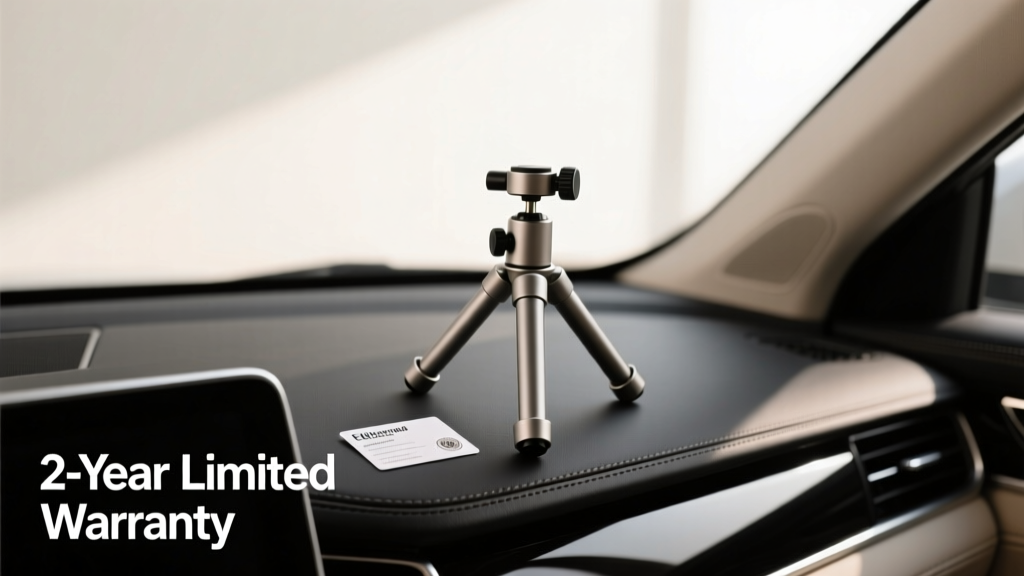
Tripod Mount Storage Warranty Coverage (2026)
A tripod mount storage system can be one of the most underrated upgrades for a well-organized car interior?especially if you carry camera gear, a phone tripod for road-trip content, a compact stand for work calls, or even a small light stand for detailing photos. The problem is that many owners buy a mount or storage solution, toss it in a door pocket, and only think about warranty coverage after a latch breaks, a clamp loosens, or the mounting hardware damages trim.
Warranties on tripod mounts and storage accessories can be confusing because they sit in a gray area between ?car interior accessory? and ?camera/tech gear.? Coverage varies widely depending on whether you?re buying an OEM accessory, a third-party interior organizer, or a camera-brand mount that happens to live in your trunk. This guide breaks down what warranties typically cover, what they exclude, and how to protect yourself?so your storage setup stays secure and your interior stays scratch-free.
Whether you?re mounting a tripod in the trunk, storing it behind a seat, or using a headrest-mounted system for quick access, you?ll learn how to read warranty terms, document your install, and make a clean claim if something fails.
What ?Tripod Mount Storage? Means (and Why Warranty Terms Differ)
?Tripod mount storage? can describe several product types, and warranty coverage often depends on which category yours falls into:
- Interior organizers with straps or buckles (seat-back organizers, cargo straps, MOLLE panels, trunk nets)
- Hard-mount brackets (bolted brackets in cargo area, floor-mounted quick-release bases, L-track accessories)
- Clamp-based mounts (headrest post clamps, rail clamps, grab-handle mounts)
- Cases used as storage (tripod bags, hard cases, foam cases stored in the vehicle)
- Hybrid systems (a storage sleeve plus a quick-release mount, or a bracket integrated into a drawer system)
In general, warranties are more generous for manufacturing defects and less forgiving for installation errors, overloading, or interior damage. If you understand what category you have, you can predict how coverage will be handled.
Warranty Basics: The Coverage You?ll See Most Often
1) Manufacturing Defects
This is the core of most warranties. It typically covers issues like:
- Broken buckles or straps under normal use
- Cracked plastic housings (not caused by impact)
- Defective welds on metal brackets
- Threaded inserts that strip due to poor machining
- Premature corrosion when used as intended
2) Workmanship and Materials
Often bundled with manufacturing defects, ?materials and workmanship? language may cover:
- Stitching that unravels on a storage sleeve
- Padding that delaminates in a soft case
- Coating failures on brackets (paint flaking unusually early)
3) Limited Lifetime vs. 1?2 Year Coverage
Here?s the practical reality:
- Limited lifetime warranty is usually ?lifetime of the product? under normal use, but with exclusions for wear items (straps, pads, adhesive) or damage caused by misuse.
- 1?2 year warranties are common for clamps, suction systems, and organizers sold as general car accessories.
Look for the word ?limited?. It means the warranty exists, but the manufacturer defines the boundaries.
What Warranties Commonly Exclude (Where Most Claims Get Denied)
Most denials fall into a few predictable categories. If you avoid these, you?ll avoid headaches.
- Overloading: Exceeding the stated weight limit (including dynamic loads from bumps and braking).
- Improper installation: Drilling, mounting to unsupported trim, or ignoring torque specs.
- Wear and tear: Frayed straps, compressed foam, scuffed surfaces, worn Velcro.
- Accidental damage: Dropping the mount, slamming a hatch on it, cargo impact.
- Environmental exposure: Heat damage from being left in a sun-baked cabin, UV cracking, chemical damage from cleaners.
- Unauthorized modifications: Cutting straps, swapping bolts, mixing parts from other brands.
- Interior damage claims: Scratches, dents, broken trim tabs?many accessory brands exclude ?consequential damage.?
Real-world example: A headrest-post tripod clamp cracks after months of use. If the clamp was tightened with pliers (instead of hand-tightened per instructions), the brand may classify it as misuse?even if the crack looks like a defect.
Car Interior Considerations: How to Protect Trim and Still Stay Covered
Tripod storage systems fail most often where metal meets plastic: headrest posts, seat rails, cargo trim, and hatch plastics. To reduce interior damage (and reduce the chance a claim gets denied), use protective interfaces that don?t require permanent mods.
Trim-safe protection tips
- Use rubber pads or felt-backed tape between clamps and interior surfaces.
- Choose seat-rail mounts that lock onto metal rails rather than plastic side skirts.
- Avoid mounting to cargo area trim panels unless the product is specifically designed for that vehicle.
- Keep straps away from sharp metal edges that can cut webbing over time.
If a product includes protective pads, use them. Skipping included pads is an easy way to lose warranty support because the manufacturer can argue you didn?t install it as designed.
How to Read a Tripod Mount Storage Warranty (Step-by-Step)
- Find the official warranty page on the brand?s site (not just the store listing). Retail listings often summarize incorrectly.
- Locate the coverage period and whether it starts at purchase date or delivery date.
- Confirm who is covered: original purchaser only vs. transferable coverage.
- Identify the ?normal use? definition. If you use it for heavy tripods, off-road driving, or commercial use, check if that?s excluded.
- Check weight limits and mounting constraints (headrest diameter, rail type, adhesive cure time, etc.).
- Read exclusions carefully, especially ?consequential damages,? ?cosmetic damage,? and ?wear items.?
- Look for required documentation: receipt, serial number, photos, proof of purchase channel (authorized seller).
- Note the remedy: repair, replacement, or store credit?and whether shipping is covered.
Quick tip: If the warranty says ?authorized sellers only,? save a screenshot of the listing showing the seller name and ?sold by? details at the time you purchased.
Filing a Warranty Claim the Right Way (Step-by-Step)
A clean claim is usually a fast claim. Here?s a process that works for most tripod mount storage products.
- Stop using the product once you notice cracking, bending, or slipping. Continued use can be labeled ?further damage.?
- Gather your documentation:
- Order confirmation or receipt (PDF is best)
- Photos of the failure from multiple angles
- Photo of the product installed (if safe to do so)
- Photo of model/serial number (if present)
- Write a short, factual description:
- Vehicle year/make/model
- Where it?s mounted (headrest posts, trunk panel, seat rail)
- Tripod weight and approximate usage frequency
- What happened and when you first noticed it
- Submit through the brand?s official portal (email is fine if that?s their process). Avoid social DMs for warranty issues.
- Keep packaging if possible. Some companies ask for return shipment before replacement.
- Ask about replacement parts if only one component failed (buckle, strap, clamp knob). Replacing a small part may be quicker than swapping the whole system.
Real-world example: If a trunk-mounted quick-release base loosens over time, send photos showing the base, the fasteners, and the mounting surface. If the company sees that you used the correct hardware and mounting points, they?re more likely to treat it as a product issue instead of an install problem.
Coverage Comparisons: OEM Accessories vs. Aftermarket vs. Camera Brands
Not all warranties are created equal. Here?s how they tend to shake out in the real world.
OEM (vehicle manufacturer) accessories
- Pros: Often better alignment with vehicle fitment; may integrate with factory cargo rails or anchor points; sometimes covered under accessory warranty when installed by the dealer.
- Cons: Limited product variety; higher price; may not be designed specifically for tripod shapes.
Aftermarket car interior accessory brands
- Pros: Broad selection (seat-back panels, cargo systems, straps, nets); good value; easy replacements.
- Cons: Warranty language can be strict on ?normal use?; interior damage usually excluded.
Camera/gear brands (tripod makers and support companies)
- Pros: Strong support for clamp mechanisms, quick releases, and hardware; replacement parts may be readily available.
- Cons: Their warranty may not cover ?vehicle mounting use? if it?s outside intended applications.
Buying tip: If you want the best warranty experience, prioritize brands that sell replacement parts (straps, buckles, clamp pads, knobs). Parts availability can matter more than the warranty length.
Product Recommendations: What Typically Holds Up Best in a Car Interior
Instead of naming one ?best? product for everyone, here are storage approaches that tend to be reliable and warranty-friendly because they avoid permanent modifications and reduce stress on parts.
1) Padded tripod bag + anchored cargo straps
- Best for: Daily drivers, family SUVs, hatchbacks
- Why it works: The bag protects the tripod; straps distribute load; fewer hard points to crack.
- What to look for: Reinforced stitching, non-slip strap adjusters, and metal or high-quality polymer buckles.
2) Seat-back organizer with long vertical pocket
- Best for: Sedans and compact cars with limited trunk access
- Why it works: Keeps the tripod out of the footwell; easy to inspect and clean.
- What to look for: Wide anchor straps, anti-sway bottom strap, and abrasion-resistant fabric.
3) Cargo rail / L-track style mounting (no-drill setups)
- Best for: SUVs and overland-style builds with factory tie-downs or rails
- Why it works: Strong, modular, and often supported by replacement hardware availability.
- What to look for: Rated tie-down points, locking fasteners, and rubber isolation to prevent rattles.
4) Headrest-post clamp mounts (use with caution)
- Best for: Lightweight tripods, quick-access setups
- Why it works: No drilling; easy to remove.
- Watch-outs: Can mar posts, loosen over time, or introduce squeaks if not padded properly.
Common Mistakes to Avoid (Warranty and Interior Damage)
- Throwing away the receipt or failing to register the product when registration is required.
- Ignoring weight ratings, especially when driving on rough roads where dynamic loads spike.
- Mounting to trim instead of structure (plastic panels aren?t structural, even if they feel sturdy).
- Over-tightening clamps to ?stop movement,? which can crack housings and void coverage.
- Using harsh interior cleaners on rubber pads or adhesives, which can cause slipping and material breakdown.
- Mixing hardware (random bolts/washers) that don?t match the manufacturer?s spec.
- Not checking for interference with airbags, seat mechanisms, or seat-belt operation.
Practical habit: Do a quick monthly check: tug the straps, confirm clamp tightness by hand, and look for webbing fray or plastic stress marks. Catching a problem early makes warranty conversations much easier.
Care Tips That Extend Life (and Help You Stay Within ?Normal Use?)
- Keep it clean: Dust and grit act like sandpaper on straps and clamp pads.
- Manage heat: If your cabin bakes in direct sun, move sensitive mounts (especially suction or adhesive-based) into the shade or trunk.
- Prevent rattles: Add thin felt tape where metal meets metal to reduce vibration wear.
- Store smart: Don?t let a tripod become a projectile. Always secure it with at least two points (strap + pocket, or strap + rail).
FAQ: Tripod Mount Storage Warranty and Coverage
Does a ?lifetime warranty? mean I?m covered forever?
Usually it means coverage for manufacturing defects for as long as you own the product (often original owner only). Wear items like straps, pads, finishes, and cosmetic scuffs are frequently excluded.
Will a warranty cover damage to my car?s interior?
Most accessory warranties don?t cover interior damage (scratches, dents, trim breaks) because it?s considered consequential damage. If interior protection matters, choose trim-safe designs and use included pads and barriers.
If I bought from an online marketplace, is my warranty still valid?
It depends on whether the seller is authorized. Many brands deny claims if the product was sold by an unauthorized third party. Save proof of the seller and check the brand?s authorized reseller list.
Can I drill into my cargo area and still keep warranty coverage?
Drilling often voids coverage unless the product explicitly supports it with instructions and templates. If you need a hard-mount solution, look for vehicle-specific kits or rail systems designed for structural mounting points.
What?s the best way to prove I used it ?normally??
Keep your receipt, take a few install photos, and document basic details like tripod weight and mounting location. If something fails, clear photos and a short timeline help support your claim.
Should I register my product?
If registration is offered, do it. Some brands require it for extended coverage, and even when it?s optional, it can speed up support since your purchase is already on file.
Actionable Next Steps
- Find your product?s warranty page and screenshot the coverage terms for your records.
- Confirm your mounting method matches the instructions (especially weight limit and clamp placement).
- Add trim protection (rubber pad or felt tape) anywhere the mount touches interior surfaces.
- Take 3?5 photos of your current setup so you have documentation if an issue appears later.
- Set a reminder to inspect straps, buckles, and clamps once a month.
If you?re building a cleaner, safer cargo area?or just trying to keep your interior organized without risking rattles and scratches?warranty know-how is part of the upgrade. Keep your paperwork, follow the install specs, and choose storage solutions designed for the way you actually drive.
Explore more car interior organization, accessory, and care guides on carinteriormix.com to keep your cabin functional, protected, and road-trip ready.