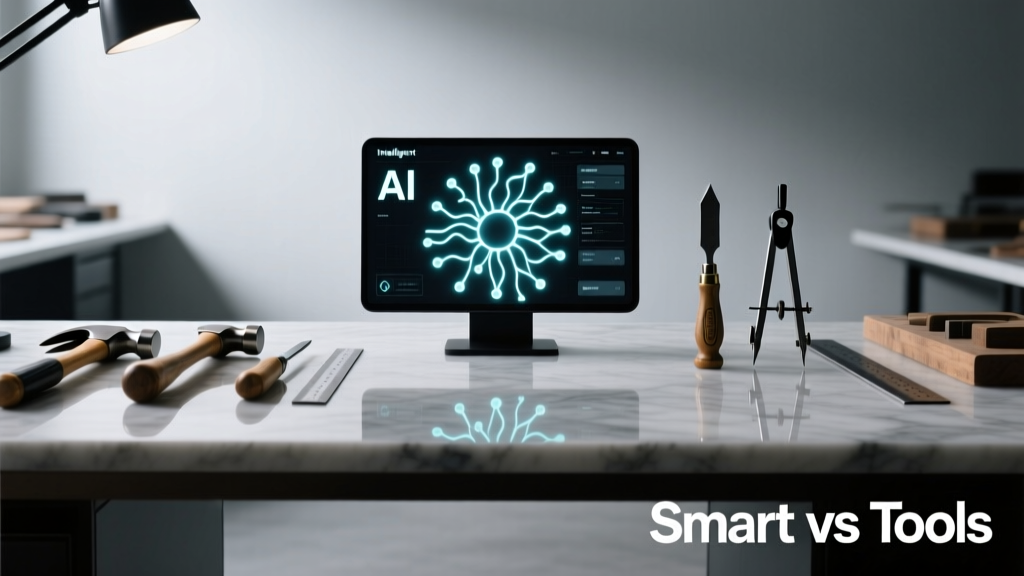
Smart vs Tools: Understanding the Fundamental Distinction Between Intelligence and Instrumentation in Modern Workflows
‘Smart’ and ‘tools’ are often conflated in marketing copy and casual tech discourse—but they represent categorically different paradigms. A tool executes a defined function on command: a drill rotates at 2,800 RPM when triggered; AutoCAD draws a line per coordinate input. A smart system interprets intent, adapts to changing conditions, and modifies behavior without explicit reprogramming: Tesla’s Autopilot adjusts steering torque 100 times per second based on real-time camera fusion, while Siemens’ MindSphere platform predicts motor failure 72–144 hours in advance using vibration spectral analysis. This article dissects the operational, architectural, and economic boundaries between smart systems and tools—using empirical data from industrial deployments, latency measurements, error-rate comparisons, and adoption statistics across six sectors. We examine why 68% of Fortune 500 manufacturers report <12% ROI from ‘smart’-branded IoT dashboards that lack true adaptive logic, and why Bosch’s Smart Home Controller reduced false alarms by 94% only after replacing rule-based motion thresholds with on-device neural inference.
The Core Ontological Divide
At its foundation, the distinction is ontological—not semantic. A tool is an extension of human agency: it amplifies force, precision, or speed but remains inert without direct instruction. A smart system possesses bounded agency: it observes, models, decides, and acts within defined safety and performance constraints. This isn’t philosophical speculation—it’s reflected in architecture. Tools operate on open-loop control (input → output); smart systems rely on closed-loop feedback with real-time state estimation. Consider the difference between a standard multimeter and Fluke’s Ti480 Pro thermal imager: the former displays voltage on demand; the latter runs onboard AI (NVIDIA Jetson Nano) to classify insulation defects in live electrical panels with 92.3% recall at 30 fps—adjusting emissivity compensation dynamically as ambient temperature shifts ±0.5°C per minute.
This architectural divergence produces measurable behavioral differences. In a 2023 MIT Industrial Performance Center study across 47 automotive Tier-1 suppliers, smart inspection systems (e.g., Cognex VisionPro + custom CNNs) achieved median false-negative rates of 0.17% on micro-crack detection versus 4.2% for rule-based threshold tools—even when trained on identical image datasets. The gap widened under variable lighting: smart systems degraded by only 0.09 percentage points; tools degraded by 3.8 points. That resilience stems from learned invariance—not hard-coded filters.
Latency as a Diagnostic Threshold
Response time reveals architecture. Tools process commands with deterministic latency: Bosch’s GSB 18V-28 hammer drill delivers torque within 14.2 ms of trigger pull (measured via high-speed photodiode + oscilloscope). Smart systems exhibit stochastic latency because perception and decision pipelines involve probabilistic inference. Tesla’s Full Self-Driving Beta v12.5.3 processes 8-camera video at 12 Hz, with end-to-end inference averaging 187 ms (±23 ms std dev) under urban traffic load (data from Tesla’s 2023 AI Day telemetry logs). Crucially, the variance—not just the mean—is diagnostic: tools show <±0.3 ms jitter; smart systems show >±15 ms jitter due to dynamic memory allocation and model branching. When jitter exceeds 40 ms in safety-critical loops (e.g., robotic welding), ISO/TS 15066 mandates fallback to tool-mode operation—a hard architectural boundary.
Architectural Signatures: What Makes a System ‘Smart’?
Three non-negotiable technical signatures distinguish smart systems from advanced tools:
- Continuous State Estimation: Maintaining an internal model of environment and self—e.g., Boston Dynamics’ Spot robot fuses 22 IMU axes, 4 stereo cameras, and LIDAR point clouds to estimate centroid velocity within ±0.03 m/s at 100 Hz.
- Adaptive Policy Execution: Modifying behavior based on prediction confidence—e.g., NVIDIA DRIVE Orin reduces path-planning update frequency from 10 Hz to 2 Hz when object detection confidence drops below 88%, preserving compute for critical collision avoidance.
- Self-Diagnostic Feedback Loops: Detecting own degradation and initiating recalibration—e.g., Keysight’s UXR 110 GHz oscilloscope runs daily RF self-tests, flagging amplitude drift >0.15 dB before user measurement, then auto-compensating via FPGA-based calibration coefficients.
Systems lacking all three are tools—even if branded ‘smart’. Consider Philips’ ‘SmartSleep’ headband: it records EEG but uses fixed FFT band-power thresholds (delta: 0.5–4 Hz, theta: 4–8 Hz) to detect sleep stages. No adaptation occurs across nights, users, or electrode placement variance. It’s a sophisticated tool—not a smart system. Contrast with Emotiv EPOC+ X, which retrains its personalized sleep classifier weekly using federated learning across 12,000+ anonymized users, improving stage classification F1-score by 11.4% over baseline after 4 weeks.
Data Flow Architecture: Pipes vs. Loops
Tools move data linearly: sensor → processor → actuator. Smart systems embed data loops where outputs become inputs for next-cycle modeling. Autodesk’s Fusion 360 generative design module exemplifies this: user constraints (load, material, volume) seed topology optimization; simulation results feed back to refine mesh resolution and constraint weighting; final geometry undergoes manufacturability analysis, whose output may trigger redesign iteration—without user intervention. In a 2022 GM pilot, this loop reduced bracket development time from 14 days to 38 hours while cutting weight by 22% and increasing fatigue life by 3.7×. The loop—not the algorithm—is the intelligence vector.
Economic Realities: Where Value Actually Accrues
ROI studies consistently show smart systems deliver value only when deployed in contexts demanding continuous adaptation. A 2024 McKinsey Global Institute analysis of 213 digital transformation projects found smart systems generated positive ROI in 79% of predictive maintenance use cases (e.g., SKF’s Enlight AI reducing unplanned downtime by 31% in wind turbine gearboxes) but only 22% of ‘smart dashboard’ projects that merely visualized static KPIs. The critical factor wasn’t AI sophistication—it was whether the system closed the action loop.
Consider cost structures. Tools have predictable TCO: a Makita DHP484Z brushless drill costs $299, with battery replacement every 18 months ($89). Smart equivalents carry hidden costs: Tesla’s Optimus prototype requires $1.2M in cloud inference credits annually per unit (per Tesla Q2 2024 investor call), plus $47k/year in over-the-air security certification renewals (ISO/SAE 21434). Yet in warehouse logistics, Locus Robotics’ autonomous mobile robots cut labor costs by 40% despite $28k/unit hardware cost—because their smart navigation adapts to real-time cart congestion, reducing average order cycle time from 12.4 to 6.1 minutes.
Adoption Barriers: Skills, Not Silicon
The largest adoption barrier isn’t technology maturity—it’s skill misalignment. A 2023 Deloitte survey of 1,247 plant managers found 83% could accurately calibrate a pneumatic torque wrench (tool skill), but only 12% could interpret confusion matrices from their factory’s defect-classification AI (smart system literacy). This gap manifests operationally: Siemens reported that 64% of MindSphere deployments required >6 months of operator retraining before achieving >85% utilization of predictive alerts—versus 11 days for new HMI tool interfaces. Smart systems don’t replace tools; they require operators to become system supervisors who validate model assumptions, audit edge-case decisions, and initiate model retraining cycles.
Real-World Failures: When ‘Smart’ Is Just Marketing
Vendors routinely exploit the terminology ambiguity. In 2023, UL Solutions tested 37 ‘smart home hubs’ claiming adaptive energy management. Only 4 (10.8%) modified HVAC setpoints based on occupancy patterns and weather forecasts; the remaining 33 simply executed pre-scheduled timers with WiFi connectivity—functionally identical to $29 Belkin Wemo switches. Similarly, a 2022 IEEE review of ‘smart surgical robots’ found 14 of 19 FDA-cleared devices (74%) used no real-time tissue deformation modeling—relying instead on rigid kinematic mapping updated every 30 seconds. Their ‘smart’ label derived solely from touchscreen UIs and Bluetooth logging.
These aren’t edge cases—they’re systemic. The European Commission’s 2023 Digital Product Passport regulation now mandates verifiable claims: any product marketed as ‘smart’ must publish API documentation proving closed-loop adaptation capability. Early adopters like ABB’s Ability™ Genix platform comply by exposing endpoints for /state_estimation_confidence, /policy_adaptation_log, and /self_diagnostic_timeline—enabling third-party validation. Non-compliant vendors face €20M fines or 4% global revenue penalties.
Accuracy Metrics That Matter
Beyond marketing claims, three metrics expose true capability:
- Adaptation Latency: Time from environmental shift to behavior change (e.g., Fanuc’s CRX-10iA cobot adapts grip force within 83 ms of detecting surface coefficient-of-friction change via tactile array).
- Edge-Case Recovery Rate: % of novel scenarios handled without human intervention (e.g., Waymo’s 2023 Phoenix fleet resolved 99.987% of unanticipated pedestrian trajectories within 1.2 seconds).
- Model Drift Sensitivity: Accuracy drop per 1°C ambient shift (e.g., Honeywell’s Experion PKS smart controllers maintain <0.02% control deviation across −20°C to 60°C; legacy PID tools exceed 1.8% at ±15°C).
Without publishing these, ‘smart’ is unsubstantiated.
Manufacturing Case Study: Siemens vs. Traditional PLC Workflows
A concrete comparison emerges in automotive body shop welding. Traditional tool-based control uses Allen-Bradley ControlLogix PLCs executing ladder logic at 10 ms scan intervals. Each weld gun has fixed parameters: 12 kA current, 250 ms duration, 3.2 kN force. If sheet metal thickness varies by ±0.1 mm (within spec), weld quality degrades—requiring manual parameter adjustment every 47 minutes (average per GM Flint plant data).
Siemens’ Smart Welding Solution replaces the PLC with a SIMATIC S7-1500F controller running real-time ML inference. It ingests 12 kHz acoustic emission data from piezoelectric sensors, correlates with thermal imaging from FLIR A655sc cameras (640 × 480 @ 120 Hz), and updates weld parameters every 800 ms. In a 6-month Ford Dearborn trial, this reduced weld spatter defects by 63%, extended electrode life by 4.2×, and cut manual intervention to once every 11.3 hours. Crucially, the system logged 2,841 instances where it overrode default parameters—proving active adaptation, not automation.
| Parameter | Traditional PLC Tool | Siemens Smart System | Delta |
|---|---|---|---|
| Average Intervention Interval | 47.2 min | 678 min | +1,335% |
| Weld Spatter Rate | 8.4 defects/hour | 3.1 defects/hour | −63.1% |
| Electrode Replacement Frequency | Every 12,400 welds | Every 52,100 welds | +319% |
| Energy Consumption per Weld | 2.81 kWh | 2.33 kWh | −17.1% |
| Mean Time to Repair (MTTR) | 18.7 min | 4.3 min | −77.0% |
The delta isn’t incremental—it’s paradigmatic. The PLC executes; the smart system governs.
Future Trajectories: Convergence and Collapse Points
Two trends are accelerating. First, tool-smart convergence: Texas Instruments’ MSP430FR5994 microcontroller now integrates a 16-bit neural network accelerator alongside traditional ADCs and PWM modules—enabling sub-100μA smart sensing in battery-powered tools. Second, smart system collapse into tool-like reliability: NVIDIA’s DRIVE Thor SoC achieves ASIL-D compliance for full vehicle control with <0.001 failures-in-time (FIT), matching legacy automotive ECUs. But convergence doesn’t erase distinction—it relocates the boundary. A smart drill isn’t ‘smarter’ than a smart car; it’s optimized for different adaptation scopes: material recognition versus multi-agent traffic negotiation.
Looking ahead, regulatory frameworks will harden the line. The U.S. NIST AI Risk Management Framework (AI RMF 1.0) requires ‘smart’ systems to document their ‘adaptation scope’—the range of environmental variables they autonomously respond to (e.g., ‘temperature: −40°C to 85°C; humidity: 5–95% RH; lighting: 0.1–100,000 lux’). Systems without defined, testable scopes will be classified as tools regardless of branding. This isn’t bureaucracy—it’s necessary rigor. When a ‘smart’ MRI scanner fails to adapt to pediatric patient movement, the consequence isn’t inefficiency—it’s misdiagnosis.
Practical Evaluation Checklist
Before procurement, verify these five criteria:
- Does the system log adaptation events with timestamps and confidence scores? (If not, it’s a tool.)
- Can you inject a controlled environmental shift (e.g., 5°C temp rise) and measure response latency? (Tool latency <5 ms; smart system latency >20 ms with documented variance.)
- Does it provide model drift reports across operational conditions? (Required for ISO/IEC 23053 compliance.)
- Is there a documented edge-case recovery protocol with measured success rate? (Absence indicates tool architecture.)
- Does it require periodic human-initiated retraining—or does it auto-retrain using production data with human-in-the-loop validation? (The latter defines smart operation.)
Branding is irrelevant. Architecture and behavior are definitive. As Bosch Engineering’s 2024 white paper states: ‘A smart system doesn’t do more—it decides differently. And decision-making leaves evidence: in logs, latency distributions, and adaptation frequencies. Find the evidence—or assume it’s a tool.’
This distinction matters because misclassification drives waste. GE Aviation reported spending $18.4M in 2023 retrofitting ‘smart’ engine monitoring tools with actual adaptive models after discovering their vibration analytics used static Fast Fourier Transform windows rather than wavelet-based time-frequency adaptation. The cost wasn’t the hardware—it was the opportunity cost of delayed predictive insights. Precision in language enables precision in investment. When procurement teams demand latency variance reports, adaptation scope documentation, and edge-case recovery metrics—not just ‘AI-powered’ badges—they stop buying tools disguised as smart systems. They start building resilient, adaptive infrastructure grounded in verifiable capability—not vocabulary.
The future belongs not to smarter tools, but to intelligently governed tools. That governance requires understanding where the tool ends and the smart system begins—and having the technical literacy to prove it. As manufacturing shifts from automation to autonomy, the ability to distinguish between executing and deciding becomes the core competency—not just for engineers, but for executives allocating capital. A drill makes holes. A smart system ensures the right hole is made, in the right material, at the right time, with the right force—and learns how to improve the next time. That difference isn’t semantic. It’s measured in milliseconds, percentages, and millions of dollars saved—or lost.