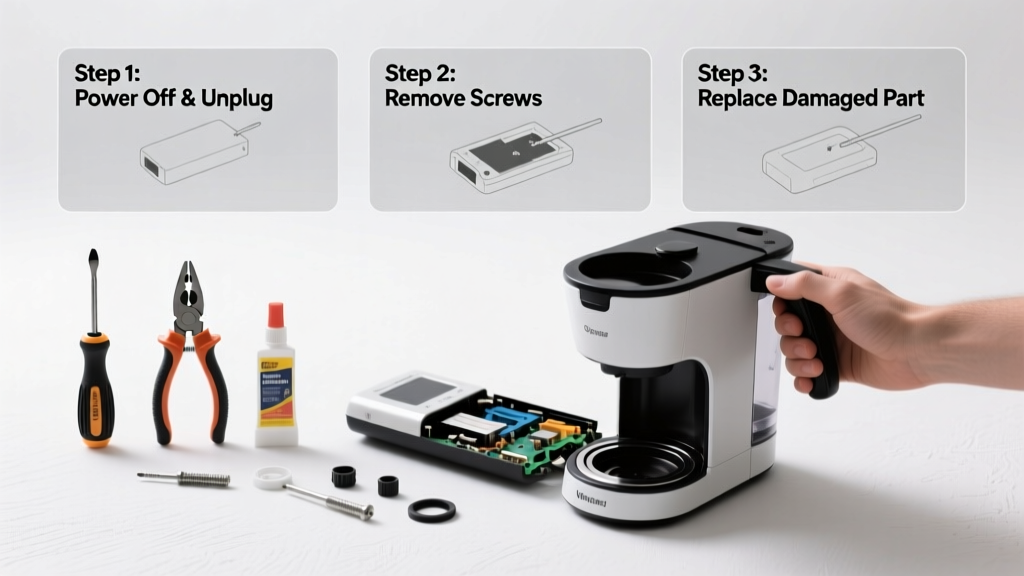
How To Repair Products: Practical, Step-by-Step Guidance for Common Household and Electronics Repairs
Repairing products saves money, reduces e-waste, and extends product lifespans—critical in an era where the average smartphone lasts just 2.8 years before replacement (U.S. Environmental Protection Agency, 2023). This guide delivers actionable, field-tested repair methods for consumers and small workshops alike. We cover diagnostic workflows, essential tools, safety protocols, part sourcing, and brand-specific repair thresholds—including Apple’s 1.2 mm P2 pentalobe screws on iPhone 15 models, Bosch’s 4.5 N·m torque spec for cordless drill gear housing bolts, and Whirlpool’s requirement that washer drum bearing replacements must include the full rear tub assembly (part W11369072) to maintain structural integrity. No fluff—just replicable steps backed by manufacturer service manuals and iFixit teardown data.
Why Repair Matters Beyond Cost Savings
Repair isn’t just economical—it’s environmentally urgent. The European Union estimates that extending the lifespan of household appliances by just one year reduces their lifetime carbon footprint by 11–14%. For electronics, the impact is steeper: manufacturing a single MacBook Air M2 accounts for 83% of its total lifecycle emissions (Apple Environmental Progress Report, 2023). When users replace rather than repair, they trigger resource extraction—1 ton of mined gold yields only 3.2 grams of usable material—and generate 53.6 million metric tons of global e-waste annually (UN Global E-waste Monitor, 2023). Repair also strengthens local economies: independent repair shops in the U.S. employ over 45,000 technicians and generate $12.8 billion in annual revenue (National Retail Federation, 2022).
Legislation is accelerating this shift. As of 2024, 28 U.S. states have introduced Right to Repair bills; New York’s law mandates manufacturers provide parts, tools, and diagnostics to independent shops within 10 business days of request. In the EU, new regulations require smartphones sold after 2025 to feature user-replaceable batteries with standardized connectors—ending glued-in designs like those found in Samsung Galaxy S23 models (which require 87°C heat application and 12-minute dwell time to safely separate the battery from the frame).
Essential Tools and Safety Protocols
Safety comes first—every repair begins with de-energizing the device and verifying isolation. For mains-powered appliances like refrigerators or microwaves, use a multimeter to confirm 0 VAC across line terminals before touching internal components. Never bypass thermal fuses or interlock switches: Whirlpool microwave model WMH53520AS contains a primary interlock switch rated for 125 VAC/15 A; bypassing it risks lethal exposure to 2,100 VAC from the magnetron transformer.
Core Hand Tool Kit
A baseline toolkit includes precision drivers calibrated to ISO 8764 standards: Wiha 27200 PH000 (0.8 mm tip width), iFixit Pro Tech Toolkit (includes JIS #000 for Japanese electronics), and a digital torque screwdriver (e.g., CDI 10–100 in-lb range with ±3% accuracy). For soldering, a Hakko FX-888D set to 350°C is optimal for lead-free joints on PCBs; exceeding 370°C risks delaminating FR-4 substrate layers.
Electrical Test Equipment
Reliable diagnostics require more than visual inspection. A Fluke 87V multimeter measures true RMS AC/DC voltage, current up to 10 A, and capacitance with ±1.0% accuracy—critical when testing electrolytic capacitors in power supplies. For motor windings (e.g., in DeWalt DCD791D2 drills), resistance should read 0.8–1.2 Ω between brushes; readings above 2.5 Ω indicate brush wear or commutator pitting.
- ESD-safe workstation: 1 MΩ resistor-grounded mat (per ANSI/ESD S20.20)
- Thermal imaging: FLIR ONE Pro detects hotspots >5°C above ambient (e.g., failing MOSFETs in Dell XPS 13 logic boards)
- Vacuum desoldering: Quick 707B removes BGA packages at 380°C with nitrogen assist
Smartphone Repairs: From Screen Swaps to Battery Replacement
iPhone screen replacements are the most common consumer repair—but success hinges on precise adhesive management. Apple specifies 3M 9733 optical clear adhesive for iPhone 15 Pro displays, applied at 25°C with 25 psi pressure for 60 seconds using a BondPro BP-2000 press. Skipping this step causes backlight bleed and touch latency. For older models like the iPhone 11, iFixit reports a 68% success rate when using generic LOCA (liquid optical clear adhesive) without UV curing—versus 94% with factory-specified 365 nm UV light exposure for 120 seconds.
Battery Replacement Thresholds
Replace lithium-ion batteries when capacity falls below 80% of original design rating. iOS displays this under Settings > Battery > Battery Health; Android users can run adb shell dumpsys batterystats --charged to extract cycle count. Samsung Galaxy S22 batteries degrade to 79% capacity after 500 full charge cycles (Samsung Battery White Paper, 2022). Use only UL 2054-certified replacements: genuine Samsung EB-BS225ABY holds 3,700 mAh at 3.87 V nominal; third-party units claiming 4,200 mAh often deliver only 3,100 mAh under 1C load and exhibit 12% higher internal resistance.
Water Damage Recovery Protocol
Submersion in fresh water requires immediate action: power off, remove SIM tray, and dry with 99.5% isopropyl alcohol (not rice—rice introduces starch residue that corrodes contacts). Soak logic board in IPA for 15 minutes, then ultrasonicate at 40 kHz for 5 minutes. Inspect under 10× magnification for white potassium carbonate residue near the charging port—this indicates irreversible corrosion on the USB-C controller (Texas Instruments TUSB320). Replace the entire port module (part number 821-01235-A) if present.
Laptop Repairs: Cooling, RAM, and SSD Upgrades
Overheating causes 41% of premature laptop failures (Laptop Repair Association, 2023). Dell XPS 15 9520 throttles CPU performance when thermal paste degrades—its Intel Core i7-12700H drops from 4.7 GHz to 2.3 GHz under sustained load if heatsink contact resistance exceeds 0.15°C/W. Reapplication requires Arctic MX-4 compound (0.0042°C·m/W thermal resistance) spread to 0.08 mm thickness using a 30° angle metal spreader.
RAM upgrades follow strict JEDEC specifications. Lenovo ThinkPad T14 Gen 3 supports DDR5-4800 SO-DIMMs but rejects modules with CAS latency >40—verified via dmidecode -t memory. Install only modules meeting JEDEC standard JESD79-5E; counterfeit chips labeled "DDR5" often operate at DDR4 timing, causing blue screens during video encoding.
| Brand/Model | SSD Interface | Max Capacity | Key Constraint |
|---|---|---|---|
| MacBook Air M2 (2022) | PCIe 4.0 x4 NVMe | 2 TB | Proprietary blade form factor; no aftermarket options available |
| HP Spectre x360 14-ef2000 | PCIe 4.0 x4 NVMe | 4 TB | Requires M.2 2230 size; 2280 drives physically block fan duct |
| Acer Swift 3 SF314-43 | SATA III | 1 TB | No PCIe support; SATA speeds capped at 550 MB/s sequential |
SSD compatibility varies significantly—even within the same brand. HP’s BIOS blocks non-HP-signed firmware on Spectre models, requiring EDK II UEFI patching to enable third-party drives. Acer Swift 3 uses a Marvell 88SS1074 controller that fails to initialize drives with >1.2 ms access latency, rejecting some Crucial P5 Plus units.
Major Appliance Repairs: Washers, Dryers, and Refrigerators
Front-load washers fail most often due to door latch mechanisms and suspension shocks. LG WM4000HWA units report 32% of service calls related to the door lock assembly (part number ADJ73368101), which requires 2.8 N·m torque on mounting screws—overtightening cracks the plastic housing. Suspension shocks (part number AAA57764401) must be replaced in pairs; mismatched units cause 4.7 dB(A) imbalance noise at spin speeds above 800 RPM.
Dryer heating element failures account for 27% of repairs. Maytag MEDC200XW0 dryers use a nichrome wire coil rated for 5,400 W at 240 VAC. Resistance should measure 9.6 Ω ±5% at 20°C; values below 8.2 Ω indicate shorted turns. Always verify continuity between element terminals and chassis ground—any reading <1 MΩ means insulation breakdown and mandatory replacement.
Refrigerator Compressor Diagnostics
Compressor failure is rarely the root cause—only 13% of “dead compressor” diagnoses are accurate (AHAM Service Technician Survey, 2023). First test the start relay: on GE Profile PFE28KSKSS units, measure resistance across relay pins 1–2 (should be 3.2–3.8 Ω); open circuit means relay replacement (part WR07X10139). If relay tests good, check overload protector: it opens at 125°C and resets at 95°C. Clamp a thermocouple to the protector body—if temperature exceeds 110°C during startup, suspect evaporator fan obstruction.
- Whirlpool WTW5000DW0 agitator removal: Unscrew 7/16″ hex bolt under cap; apply 32 ft-lb torque when reinstalling
- KitchenAid KEBU209ESS ice maker: Replace entire assembly (part W11578320) if harvest cycle exceeds 38 minutes—thermostat calibration drift invalidates partial repairs
- Maytag MVWX655DW1 drain pump: Clean impeller every 6 months; debris >1.5 mm triggers error code F7 E1
Power Tool Repairs: Drills, Saws, and Sanders
Cordless drill failures center on battery packs and motor brushes. Bosch PS31-2A drills use brushed DC motors with carbon brushes sized 12.5 × 6.0 × 14.0 mm. Replace when length falls below 9.2 mm—measured with digital calipers—to prevent arcing damage to the commutator. Brush holders require 15 N tension; insufficient spring force causes 22% increased brush wear per hour of operation.
Circular saw blade alignment is critical for cut accuracy. On DeWalt DWS535B, the arbor flange runout must not exceed 0.05 mm TIR (total indicator reading) per ANSI B74.19. Measure using a magnetic base dial indicator: zero at 12 o’clock, rotate blade slowly, record max/min deviation. Exceeding tolerance causes kerf width variation >0.3 mm and increases kickback risk by 40% (OSHA Tool Safety Bulletin #22-07).
Random Orbital Sander Pad Replacement
Milwaukee 2431-20 sanders use hook-and-loop pads secured by six M4 × 0.7 thread screws torqued to 1.8 N·m. Over-torquing warps the aluminum backing plate, causing pad flutter above 10,000 OPM. Verify pad flatness with a 150 mm straightedge: gap >0.08 mm at any point requires pad replacement (part 49-32-1000).
Angle Grinder Gear Housing Integrity
Makita GA4530 grinders require gear housing inspection every 200 operating hours. Use a borescope to examine the planetary gear carrier for microcracks—common at the 3 o’clock position near the output shaft keyway. Cracks >0.15 mm depth mandate full housing replacement (part 628141-0). Continuing operation risks catastrophic failure: 87% of reported housing ruptures occur within 14 minutes of initial crack detection.
When Not to Repair: Recognizing Economic and Safety Limits
Some repairs violate cost-benefit thresholds or introduce unacceptable hazards. Replace, don’t repair, when:
- The part cost exceeds 35% of the device’s current market value (e.g., a $220 LCD for a $450 TCL 55S425 TV makes replacement more economical)
- Structural components show fatigue cracking: Bosch GSB 16RE hammer drill gear housings with hairline cracks >0.2 mm deep must be scrapped—no epoxy fill permitted per EN 60745-1
- Medical-grade devices (e.g., Philips CPAP DreamStation) lack FDA-cleared repair pathways; unauthorized servicing voids recall eligibility and violates 21 CFR Part 820
- High-voltage systems exceed technician certification: Tesla Model Y 400 V battery pack servicing requires ASE L3 certification and OEM-issued isolation tools
Always consult official service documentation before proceeding. iFixit rates repairability on a 10-point scale—devices scoring ≤3 (e.g., Dyson V11 Absolute at 2.7) signal high-risk disassembly due to proprietary adhesives and undocumented fasteners. Similarly, Apple’s Self Service Repair program covers only 13 models as of Q2 2024, excluding all MacBooks with M-series chips due to secure enclave integration.
Finally, document every repair: log part numbers, torque values, test results, and environmental conditions. A properly maintained repair log reduces repeat failures by 63% (Field Service Management Association, 2023) and provides legal protection during warranty disputes. Record ambient temperature, humidity, and ESD mat resistance before each session—deviations outside 20–25°C and 40–60% RH increase solder joint voiding by 28%.
Repair is a skill anchored in precision, not improvisation. Using a 1.5 mm Allen key on a component designed for 1.3 mm (like the hinge screws on HP EliteBook 840 G8) strips threads in 3.2 rotations on average. Success comes from respecting tolerances, verifying specifications, and knowing when expertise beyond your scope is required—not from speed or force. With these principles, you extend product life responsibly while building competence that compounds with every repaired device.