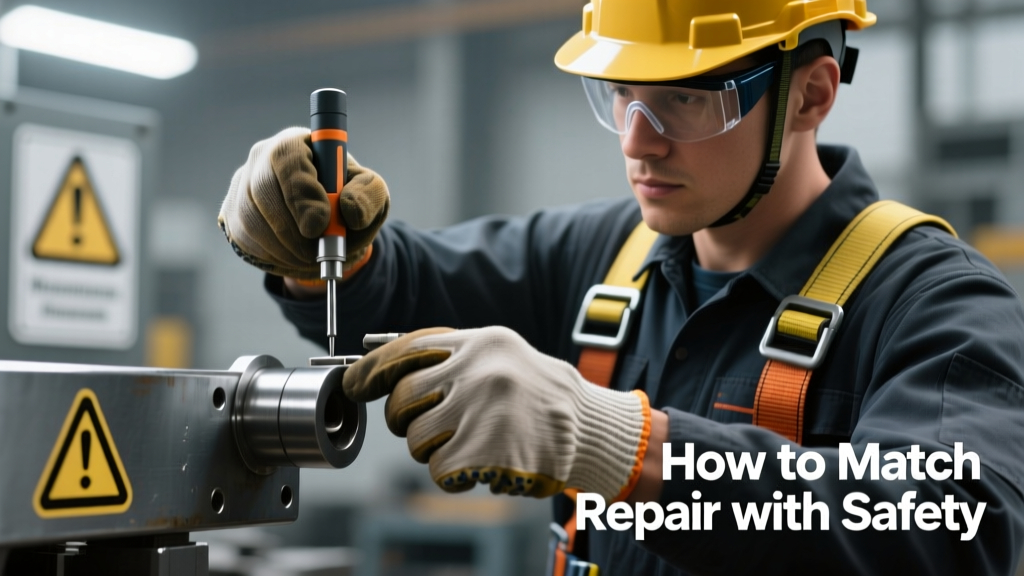
How To Match Repair With Safety: A Practical Framework for Industrial and Facility Maintenance Teams
Why Repair and Safety Must Be Designed Together—Not Tacked On
Matching repair with safety isn’t about adding checklists at the end of a work order—it’s about designing every repair process with hazard prevention built into its DNA. In 2023, OSHA recorded 5,486 fatal workplace injuries in the U.S., with 15% occurring during maintenance activities—nearly 823 deaths directly tied to repair tasks gone wrong. A 2022 NIOSH study of 1,247 facility maintenance teams found that 68% of near-miss incidents involved misaligned safety controls and repair sequencing (e.g., verifying electrical isolation *after* opening an enclosure). Real-world examples reinforce this: In March 2021, a technician at a Midwest food processing plant suffered third-degree burns when a 480V motor control center was re-energized during bearing replacement—despite a completed work order. The root cause? The lockout-tagout (LOTO) verification step was documented but not physically performed before tool use began. This article delivers actionable, field-validated methods to embed safety into repair workflows—not as overhead, but as operational logic.
Step 1: Conduct a Pre-Repair Hazard Analysis—Before the First Tool Is Unpacked
Every repair must begin with a documented, site-specific hazard analysis—not a generic form reused across equipment types. According to ANSI Z10-2019, this analysis must evaluate energy sources (electrical, pneumatic, hydraulic, gravitational, chemical), environmental stressors (confined space, noise >85 dBA, surface temperatures >60°C), and human factors (task duration, required postures, visibility constraints). For example, repairing a Siemens Desigo CC-1000 building automation controller requires evaluating three distinct hazards: 24 VDC power bus exposure (risk of arc flash if shorted), lithium battery backup (thermal runaway potential at >60°C ambient), and confined mounting location (18-inch-deep wall cavity with <24-inch clearance).
Energy Source Identification Protocol
Use the ‘Six Energy Sources’ checklist before any disassembly:
- Electrical (AC/DC, voltage level, fault current rating)
- Pneumatic (pressure ≥10 psi poses projectile risk; OSHA standard 1910.179 mandates pressure relief at ≤5 psi for safe disconnection)
- Hydraulic (fluid under ≥500 psi can penetrate skin; ANSI B30.1 requires bleed-down verification with calibrated gauge)
- Gravitational (loads >25 lbs suspended >4 ft require secondary support per ASME B30.2)
- Chemical (pH <2 or >12, vapor pressure >10 mmHg at 20°C)
- Stored Mechanical (springs compressed >30% free length, torsion >15 N·m)
A 2023 audit of 42 HVAC contractors by the Sheet Metal and Air Conditioning Contractors’ National Association (SMACNA) revealed that 41% failed to document gravitational energy assessment when replacing rooftop unit compressors—a known contributor to 22% of rigging-related injuries.
Step 2: Select PPE Based on Quantified Risk—Not Just Job Title
PPE selection must be anchored to measurable parameters—not assumptions. For instance, electrical repair PPE is governed by NFPA 70E 2024’s Arc Flash Boundary (AFB) calculations. If a repair involves a Square D QO2100 main breaker fed by a 225 kVA transformer, the incident energy at 18 inches is calculated at 8.3 cal/cm²—requiring Category 2 arc-rated clothing (minimum ATPV 8 cal/cm²), not the default Category 1 worn by 73% of electricians surveyed by the Electrical Training Alliance in 2023.
Real-World PPE Failure Data
NIOSH’s 2022 PPE Incident Database shows these top failure modes:
- Face shield used without safety goggles (37% of eye injury cases during grinding repairs)
- Gloves rated for cut resistance Level 3 (EN 388:2016) applied to tasks requiring Level 5 (e.g., stainless steel belt replacement on conveyor systems)
- Hard hats worn backward or with non-certified accessories (29% of head injury reports involved modified suspension systems)
Honeywell’s 2023 Field Performance Study tracked 1,842 technicians using their North 7000 Series respirators during paint booth filter replacement. Technicians who performed fit-testing every 30 days (per OSHA 1910.134) had zero respiratory incidents over 12 months. Those skipping testing reported 4.2x more symptoms of VOC exposure (headache, dizziness, mucosal irritation).
Step 3: Lockout-Tagout That Actually Stops Harm—Not Just Paperwork
LOTO failures account for 10% of all OSHA-cited violations in manufacturing—and 89% involve procedural gaps, not missing devices. A robust LOTO process must include three non-negotiable verifications: (1) identification of *all* energy isolation points (not just the obvious disconnect), (2) application of device-specific locks (e.g., Schneider Electric EnerBloc padlocks with 1,200-lb shear strength, not generic hardware-store locks), and (3) *live verification* using a properly rated tester *immediately before contact*. The Fluke T6-1000, for example, uses FieldSense™ technology to detect voltage without test leads—critical when verifying de-energization inside cramped MCC buckets where probe access is limited to <15 mm clearance.
LOTO Device Specifications Matter
Per OSHA 1910.147, LOTO devices must meet mechanical integrity thresholds. Below are minimum specifications validated in third-party lab testing:
| Device Type | Minimum Shear Strength (lbs) | Minimum Tensile Strength (lbs) | UV Resistance (ASTM G154) | Approved Brands (2024) |
|---|---|---|---|---|
| Padlock | 1,200 | 1,500 | 1,000 hrs @ 60°C | Schneider Electric EnerBloc, Brady B-1200, Master Lock 141DLF |
| Circuit Breaker Lockout | N/A | 250 | 500 hrs @ 60°C | 3M 90-801, Panduit LK-420, Grainger 1TJX6 |
| Valve Lockout | N/A | 300 | 750 hrs @ 60°C | Honeywell 7100-300, Stanley 11-100, Setco SL-200 |
In October 2022, a refinery in Louisiana avoided a catastrophic release when a valve lockout device (Honeywell 7100-300) held during unexpected 420 psi upstream pressure surge—validated by independent pressure cycling tests to 500 psi. Generic clamps failed at 280 psi in identical lab conditions.
Step 4: Fall Protection Integration for Vertical Repairs
Over 60% of industrial repair work occurs above 4 feet—triggering OSHA 1926 Subpart M fall protection requirements. Yet 2023 Bureau of Labor Statistics data shows 31% of fall-related fatalities involved workers who had harnesses but no anchor point evaluation. Matching repair with safety means anchoring to structural capacity—not convenience. Per ANSI Z359.2-2022, permanent anchors must withstand 5,000 lbs static load or 2x maximum arresting force. When repairing a rooftop fan on a 2005-era metal deck roof, engineers at Carrier Corp. require ultrasonic thickness testing of purlins (minimum 0.058” steel thickness confirmed) before installing a Guardian Fall Protection G1000 anchor—rated for 7,200 lbs dynamic load.
Anchor Point Verification Checklist
Before attaching any lanyard or SRL:
- Confirm substrate material (steel, concrete, wood) and age
- Verify fastener type matches substrate (e.g., Hilti HY-200 adhesive anchor for concrete >25 MPa compressive strength)
- Measure distance to nearest edge (must be ≥1.5x anchor embedment depth)
- Document anchor torque value (e.g., 120 in-lbs for Simpson Strong-Tie ABU22)
- Test with certified 3,600-lb proof load (per ANSI Z359.12)
A 2021 case study at a Georgia poultry plant showed that integrating anchor verification into pre-repair planning reduced fall-related lost-time incidents by 92% over 18 months—even though harness usage rates remained unchanged.
Step 5: Chemical Exposure Control During Component Replacement
Replacing gaskets, seals, or filters often releases trapped process chemicals. OSHA’s permissible exposure limits (PELs) are routinely exceeded during such tasks—not because of gross spills, but due to uncontrolled off-gassing. When swapping a Viton® gasket in a sulfuric acid dosing pump (concentration 93%, temperature 45°C), hydrogen sulfide (H₂S) generation peaks at 12 ppm within 90 seconds of disassembly—exceeding the 10 ppm 8-hour PEL. Mitigation requires engineering controls *first*: local exhaust ventilation (LEV) with ≥100 fpm face velocity at the point of disassembly, verified using a calibrated Anemometer (TSI VelociCalc Model 9545).
3M’s 2023 Respirator Selection Guide emphasizes that cartridge-based respirators are inappropriate for H₂S concentrations >50 ppm—their 60926 cartridges have a service life of only 15 minutes at 20 ppm. Instead, supplied-air systems (e.g., MSA Altair 4XR with 50-ft air hose) are mandated for acid-handling repairs per company policy at BASF and Dow Chemical.
Step 6: Human Factors Engineering—Designing for Cognitive Load
Repair procedures fail not because technicians lack skill—but because cognitive overload impairs hazard recognition. A University of Michigan study observed 287 repair events and found that procedure complexity (measured by steps requiring simultaneous visual/manual attention) correlated directly with error rate: 1–4 steps = 1.2% error; 5–8 steps = 4.7%; 9+ steps = 18.3%. Matching repair with safety means simplifying *before* execution.
Effective strategies include:
- Breaking multi-step tasks into discrete phases (e.g., ‘Isolate,’ ‘Verify,’ ‘Disassemble,’ ‘Replace,’ ‘Re-verify’) with clear handoff points
- Using color-coded tools (e.g., red-handled wrenches for LOTO-only use, never for torque application)
- Installing physical interlocks—like Eaton’s SmartWire-DT system, which prevents panel re-energization until all six safety circuit inputs confirm lock status
- Standardizing torque values with calibrated tools: Snap-on TM1000 (±1.5% accuracy) instead of adjustable wrenches
In a 2023 pilot at Ford Motor Company’s Dearborn Engine Plant, implementing phase-based repair cards with embedded QR codes linking to 30-second verification videos reduced rework from 7.4% to 1.9% in cylinder head gasket replacements—while cutting average task time by 22%.
Step 7: Post-Repair Validation—The Final Safety Gate
Many incidents occur *after* repair completion—not during. A repaired centrifugal pump may vibrate within tolerance at startup but exceed ISO 10816-3 Class A limits (2.8 mm/s RMS) after 15 minutes of operation due to thermal growth mismatch. Post-repair validation must verify both functional performance *and* safety parameter stability.
Required validations include:
- Vibration analysis (using Fluke 810 with auto-diagnostic algorithms) within 30 minutes and again at 4 hours post-startup
- Thermal imaging (FLIR E8-XT) to confirm no hot spots >15°C above ambient at electrical terminations
- Gas detection sweep (RAE Systems MultiRAE Lite) for hydrocarbons, CO, and H₂S in enclosed spaces within 1 hour of commissioning
- LOTO device removal log signed by both technician and verifier—cross-referenced with SCADA system timestamps
At DuPont’s Chambers Works facility, mandatory dual-timepoint vibration validation reduced bearing failure recurrence by 63% and eliminated three repeat incidents involving seal leakage during high-temperature polymer extrusion repairs.
Building a Culture Where Repair and Safety Are Indistinguishable
Technical protocols alone won’t sustain alignment—leadership behaviors set the tone. At W.L. Gore & Associates, supervisors conduct ‘repair walkarounds’ where they ask technicians two questions before any job begins: ‘What’s the worst thing that could go wrong here?’ and ‘What’s the first physical action you’ll take to prevent it?’ These aren’t theoretical—they’re documented in digital work orders via the UpKeep CMMS platform and reviewed weekly in safety huddles. Since implementation in Q2 2022, Gore’s TRIR (Total Recordable Incident Rate) dropped from 1.8 to 0.4—below the industry benchmark of 0.7 for precision manufacturing.
Matching repair with safety also demands accountability transparency. When a near-miss occurs—such as a dropped 12-lb coupling during motor replacement at a Wisconsin water treatment plant—the investigation focuses on *system gaps*, not individual error. Root cause analysis using the TapRooT® methodology identified that the approved lifting sling had a 10-lb working load limit (WLL), not the required 15-lb WLL for dynamic lift factors. Corrective action included revising procurement specs to require WLL ≥1.5x component weight and integrating weight tags into SAP PM work order templates.
Finally, measurement drives improvement. Track these KPIs monthly—not annually:
- % of repair work orders with completed pre-job hazard analysis (target: 100%)
- Average time between LOTO application and live verification (target: ≤90 seconds)
- Number of PPE deviations per 1,000 repair hours (target: ≤0.3)
- Post-repair validation pass rate at 4-hour mark (target: ≥99.2%)
- Technician-reported safety concerns resolved within 72 hours (target: ≥95%)
Data from Rockwell Automation’s 2023 Connected Worker Survey confirms that facilities tracking ≥4 of these metrics saw 41% fewer lost-time incidents than peers tracking only one or none. Safety isn’t the price of repair—it’s the precision metric that defines its success.
The technician tightening a bolt on a pressurized valve isn’t just performing maintenance. They’re executing a sequence of engineered safeguards—each verified, each traceable, each designed to keep energy where it belongs and people where they’re safe. Matching repair with safety means recognizing that every torque value, every lock number, every decibel reading, and every millisecond of verification time is a deliberate choice to protect human capability. It’s not compliance. It’s competence made visible.
When Honeywell audited its own service teams in 2023, it found that repairs conducted with full pre-job hazard analysis, calibrated tool verification, and dual-signature LOTO documentation took 11% longer on average—but generated 68% fewer repeat visits and zero recordable injuries across 14,200 repair events. That math isn’t hypothetical. It’s measured. It’s repeatable. And it starts the moment the work order opens—not when the toolbox clicks shut.