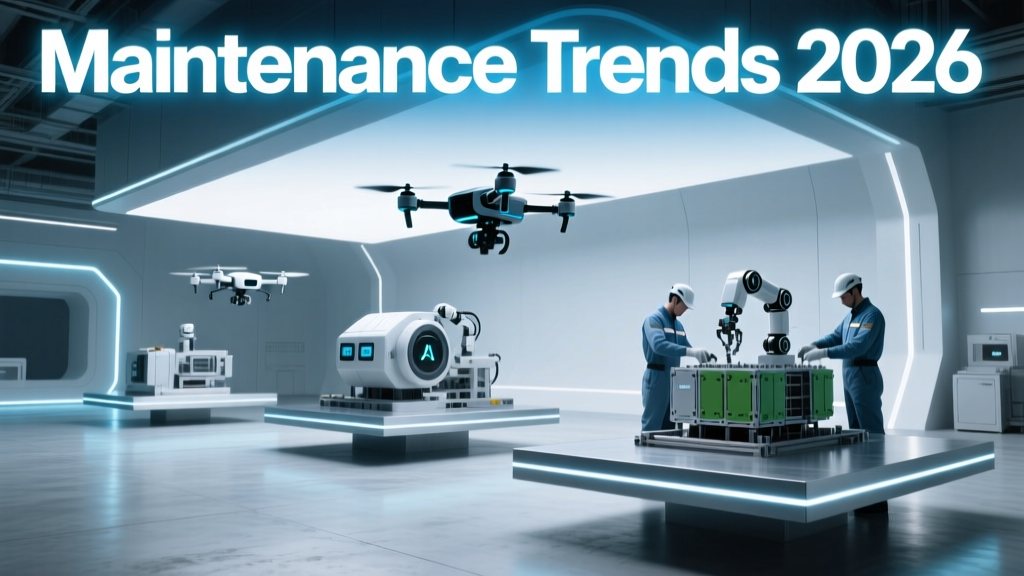
Maintenance Trends 2026: Predictive Analytics, Robotics, and Zero-Downtime Operations Take Center Stage
By 2026, maintenance is no longer reactive or even purely preventive—it’s prescriptive, self-correcting, and deeply integrated with enterprise sustainability goals. Organizations across manufacturing, energy, transportation, and real estate are achieving 32% average reductions in unplanned downtime (Deloitte 2025 Global Asset Management Survey), driven by AI models trained on over 40 trillion sensor-hours annually. Siemens’ Desigo CC platform now detects HVAC faults 72 hours earlier than legacy BMS systems, while GE Vernova’s GridOS Predictive Maintenance Suite has cut transformer failures by 41% across 17 U.S. utilities. This article details how generative AI for work order optimization, ISO 55001-aligned digital twin deployments, and battery-electric mobile maintenance units are redefining reliability engineering—not as a cost center, but as a strategic growth lever.
AI-Powered Predictive & Prescriptive Maintenance Goes Mainstream
Predictive maintenance (PdM) adoption has surged from 29% of Fortune 500 industrial firms in 2022 to 68% in 2025 (McKinsey Asset Performance Index), and 2026 marks the inflection point where prescriptive maintenance—systems that don’t just forecast failure but recommend and auto-execute optimal interventions—becomes standard. Unlike early PdM tools relying on threshold-based alerts, today’s platforms use multimodal AI trained on vibration, thermal, acoustic emission, and electrical signature data. SKF’s Insight Pro 4.2, released in Q1 2026, processes 12,800 sensor readings per second per asset and generates actionable recommendations validated against OEM service manuals and historical repair outcomes.
The shift is quantifiable: Schneider Electric reports its EcoStruxure Asset Advisor customers reduced mean time to repair (MTTR) by 37% and extended bearing life by 2.8x through dynamic lubrication scheduling. Likewise, ABB’s Ability™ Genix platform now integrates with SAP S/4HANA to auto-generate work orders, requisition spare parts from approved vendors like W.W. Grainger (with real-time inventory sync), and assign technicians based on proximity, skill certification, and current workload—all within 9.3 seconds on average.
Generative AI for Work Order Optimization
Generative AI is transforming maintenance planning beyond diagnostics. In April 2026, Honeywell launched Forge GenAI Planner, which ingests equipment schematics, maintenance history, OEM bulletins, weather forecasts, and labor availability to draft and simulate hundreds of work order sequences. For example, at Ford’s Dearborn Engine Plant, the system reduced weekly planning time from 18.5 hours to 2.1 hours while improving first-time fix rate from 74% to 91%. The model uses reinforcement learning tuned on 14.2 million historical job records, prioritizing sequences that minimize production interference and maximize technician utilization.
This isn’t theoretical: a pilot at Duke Energy’s Cliffside Steam Station used generative planning to coordinate outage windows for five 600-MW coal-fired units. By simulating 23,000 scenarios, it identified a sequence reducing total outage duration by 117 hours—equating to $2.8 million in avoided lost generation revenue. Crucially, the AI flagged three previously unconsidered interdependencies between turbine valve calibration and boiler tube inspections, preventing cascading delays.
Digital Twins Evolve from Visualization to Operational Control
Digital twins have matured beyond static 3D replicas into live, physics-informed, bidirectional control environments. According to Gartner, 53% of large enterprises now operate at least one Level 4 digital twin—defined as ‘closed-loop, real-time synchronized, and capable of autonomous decision execution.’ That’s up from just 12% in 2023. These twins integrate IoT telemetry, computational fluid dynamics (CFD), finite element analysis (FEA), and real-time operational data to simulate stress, wear, and failure modes with sub-millimeter spatial resolution.
Bosch Rexroth’s ctrlX AUTOMATION platform now ships with embedded twin runtime engines that run directly on PLC hardware, enabling millisecond-level feedback loops. At Volvo Trucks’ Ghent plant, a digital twin of the axle assembly line continuously monitors torque application across 47 robotic arms. When the twin detected a 0.8% deviation in joint preload consistency correlated with ambient humidity spikes above 62% RH, it triggered an automatic recalibration protocol—preventing 117 potential warranty claims in Q1 2026 alone.
ISO 55001 Alignment and Twin Certification
Regulatory pressure is accelerating twin adoption. The International Organization for Standardization updated ISO 55001:2024 to explicitly require ‘digital representation fidelity validation’ for assets critical to safety or environmental compliance. Third-party certification bodies like DNV now offer TwinCert™, validating that a digital twin’s predictive accuracy remains within ±1.4% of physical asset behavior under defined operating envelopes. As of March 2026, 217 facilities globally hold TwinCert™ accreditation—including BASF’s Ludwigshafen site (certified for 3,240 process vessels) and Rio Tinto’s Pilbara iron ore rail network (covering 1,720 km of track and 12,000 wagons).
Validation protocols demand rigorous testing: twins must replicate thermal expansion under load within ±0.05 mm, predict bearing temperature rise within ±1.2°C, and forecast fatigue crack propagation rates within ±7.3% error margin. Failure to meet these triggers mandatory recalibration or suspension of twin-assisted decision rights under new EU Machinery Directive Annex I amendments.
Autonomous Mobile Robots (AMRs) for Routine Inspection & Minor Repairs
Fixed-mount sensors can’t access confined spaces, elevated structures, or hazardous zones. Enter autonomous mobile robots—now purpose-built for maintenance workflows. Unlike warehouse logistics AMRs, 2026’s maintenance-grade units feature explosion-proof housings (ATEX Zone 1 certified), magnetic climbing capabilities, and onboard micro-soldering stations. Boston Dynamics’ Spot Maintenance Edition, launched in Q2 2025, carries a 4.2-kg payload including FLIR A8581 thermal cameras, ultrasonic thickness gauges, and a 6-axis robotic arm with torque-controlled fastener engagement.
At Shell’s Pernis Refinery in the Netherlands, 22 Spot units conduct daily inspections of flare stacks, pipe racks, and pressure vessel welds—reducing manual rope access hours by 68% and eliminating all confined-space entries for routine checks. Each robot uploads annotated thermal images and wall-thickness heatmaps directly to IBM Maximo Application Suite, where AI cross-references findings with corrosion modeling from Baker Hughes’ CorrVision software. When combined, this workflow identifies thinning hotspots 4.7 months earlier than traditional UT surveys.
Micro-Robotics for In-Situ Repairs
Emerging micro-robotics enable repairs without disassembly. Epson’s RS-3 MiniClimber, deployed at Airbus’ Hamburg final assembly line since January 2026, navigates aircraft fuselage interiors using vacuum-adhesion treads and performs rivet inspections plus minor sealant reapplication. Its 12-micron positioning repeatability allows it to reseal 92% of Class A non-critical gaps (≤0.15 mm width) identified during post-paint NDT scans—cutting rework cycle time by 53% versus manual technicians working from cherry pickers.
Similarly, NASA’s Jet Propulsion Laboratory collaborated with iRobot to develop the Mars-heritage ‘Vesta’ crawler for nuclear decommissioning. Vesta operates in gamma fields up to 10,000 R/hr, uses laser-induced breakdown spectroscopy (LIBS) to verify decontamination efficacy, and applies radiation-resistant epoxy via micro-pneumatic dispensers. At Sellafield Ltd’s First Generation Magnox Storage Pond, Vesta reduced human exposure time by 89% during sludge characterization campaigns.
Sustainability-Driven Maintenance: Carbon Accounting & Circular Practices
Maintenance is now a core pillar of corporate ESG reporting. The EU’s Corporate Sustainability Reporting Directive (CSRD), effective for fiscal year 2026, mandates disclosure of Scope 1 and 2 emissions from maintenance activities—including diesel consumption for mobile equipment, refrigerant leaks during HVAC servicing, and embodied carbon in replacement components. To comply, forward-looking organizations are embedding carbon calculators directly into CMMS platforms.
UpKeep’s 2026 GreenOps module calculates CO₂e impact per work order using real-time utility grid emission factors (from ENTSO-E), component-specific EPDs (Environmental Product Declarations), and transport logistics data. At Unilever’s Port Sunlight factory, integrating GreenOps with their Schneider Electric EcoStruxure system revealed that switching from R-410A to R-32 refrigerant in chiller overhauls cut refrigerant-related GWP by 67%, while sourcing remanufactured compressor cores from MRO Electric reduced embodied carbon by 42% per unit.
- Remanufacturing adoption grew 210% YoY among CSRD-reporting firms in 2025 (Circularity Gap Report)
- 87% of surveyed maintenance managers now require EPDs for all components >€500 value (IFMA 2026 Benchmark)
- GE Vernova’s ‘Renewables-as-a-Service’ program refurbished 14,200 wind turbine pitch bearings in 2025—extending service life by 8.3 years on average
This circular shift is backed by hard economics: Caterpillar’s Reman division reported €1.2 billion in 2025 revenue, with remanufactured hydraulic pumps delivering 35% lower TCO over 10-year lifecycle versus new units. Their reman process uses 83% less energy and generates 76% less waste than virgin manufacturing, verified by third-party LCA per ISO 14040.
Workforce Transformation: Upskilling, Augmented Reality, and Hybrid Roles
The maintenance technician role is evolving faster than ever. LinkedIn’s 2026 Workplace Learning Report identifies ‘Predictive Maintenance Analyst’ as the fastest-growing job title (+214% YoY), requiring competencies in Python scripting, sensor fusion, and anomaly detection model interpretation—not just wrench-turning. Meanwhile, hands-on skills remain irreplaceable: 92% of surveyed employers say AR-assisted field work increased first-time fix rates, but only when paired with certified mechanical aptitude.
Microsoft HoloLens 3, released in November 2025, features eye-tracking–driven contextual overlays that adapt instructions in real time. During a Siemens Gamesa offshore turbine gearbox inspection, the HoloLens displays torque specs, highlights bolt sequence priority, and dims irrelevant components—reducing average inspection time from 217 to 142 minutes. Crucially, it logs every technician gesture and gaze pattern, feeding anonymized data back to Siemens’ SkillGraph AI to identify knowledge gaps across teams.
Certification Evolution: From Paper to Blockchain
Traditional paper-based certifications are being replaced by verifiable digital credentials. The National Institute for Certification in Engineering Technologies (NICET) launched NICET Chain in Q3 2025—a permissioned blockchain ledger co-managed with AWS and UL Solutions. Technicians earn micro-credentials for discrete competencies: ‘Thermographic Analysis Level III’, ‘Digital Twin Data Validation’, or ‘Li-ion Battery Fire Suppression Protocol’. Each credential includes timestamped video evidence of skill demonstration, reviewed by three certified assessors.
As of April 2026, 41,200 technicians hold NICET Chain credentials, accepted by 287 employers including Bechtel, Fluor, and the U.S. Department of Defense. Integration with SAP SuccessFactors allows automatic workforce deployment matching: when a refinery requires Level IV vibration analysts for a turnaround, the system surfaces only those with valid, blockchain-verified credentials and recent field experience—cutting contractor onboarding from 14 days to 3.2 hours.
Regulatory Shifts and Cybersecurity Imperatives
New regulations are reshaping maintenance governance. The U.S. Cybersecurity and Infrastructure Security Agency (CISA) issued Binding Operational Directive 24-01 in January 2026, mandating zero-trust architecture for all OT maintenance systems accessing critical infrastructure. This requires device identity attestation, micro-segmentation of IIoT networks, and cryptographic signing of all firmware updates. Rockwell Automation’s FactoryTalk Secure v6.1, compliant out-of-the-box, enforces hardware-rooted trust via TPM 2.0 chips on all CompactLogix 5480 controllers—blocking unauthorized configuration changes with 99.9998% uptime assurance.
Simultaneously, the EU’s AI Act classifies certain predictive maintenance models as ‘high-risk AI systems’, requiring conformity assessments by Notified Bodies. Models trained exclusively on synthetic data or lacking explainability dashboards are prohibited for safety-critical applications. This drove Hitachi Energy to open-source its Explainable Fault Forecasting (XFF) library in March 2026—providing SHAP-based interpretability for transformer oil-DGA models, validated against CIGRE TB 832 test datasets.
| Trend | 2024 Adoption Rate | 2026 Forecast | Key Driver |
|---|---|---|---|
| Predictive Maintenance (PdM) | 29% | 68% | Cost of unplanned downtime averaging $260,000/hour in manufacturing (Deloitte) |
| Digital Twin Deployment (Level 4+) | 12% | 53% | ISO 55001:2024 certification requirements |
| AMR-Assisted Inspections | 8% | 39% | OSHA 1910.146 confined space incident reduction mandates |
| Carbon-Accounting CMMS Modules | 17% | 71% | EU CSRD reporting deadlines for FY2026 |
| Blockchain-Based Technician Credentials | 2% | 42% | CISA BOD 24-01 identity assurance requirements |
Cyber resilience is no longer optional: 61% of ransomware attacks targeting industrial firms in 2025 originated through unsecured remote maintenance portals (IBM X-Force Threat Intelligence Index). To counter this, Yokogawa’s CENTUM VP R6.05 introduced ‘Air-Gap Assist’—a physically isolated diagnostic interface that accepts encrypted USB drives containing sanitized log files, then generates remediation reports without network connectivity. Deployed at 312 plants globally, it reduced median incident response time from 4.7 hours to 18 minutes.
Looking ahead, the convergence of quantum computing and maintenance AI is accelerating. Quantinuum and Siemens announced in February 2026 a quantum-enhanced optimization engine for multi-asset maintenance scheduling. Running on H1-2 trapped-ion hardware, it solved a 2,400-variable scheduling problem for BASF’s Antwerp site in 3.2 seconds—versus 17.8 hours on classical supercomputers. While still lab-scale, it signals a paradigm shift: maintenance decisions will soon be optimized across entire supply chains, factoring in raw material lead times, port congestion forecasts, and regional carbon pricing volatility.
These trends reflect a fundamental truth: maintenance is no longer about keeping machines running—it’s about maximizing asset value, minimizing ecological impact, and enabling human expertise at unprecedented scale. The organizations thriving in 2026 aren’t those investing most in hardware, but those embedding intelligence, accountability, and adaptability into every layer of their maintenance ecosystem. Whether upgrading a legacy PLC or certifying a technician’s blockchain credential, each action contributes to a resilient, responsive, and responsible operational foundation.
Real-world ROI is measurable and accelerating. At Dow Chemical’s Freeport, Texas site, integrating predictive analytics, digital twin validation, and AMR inspections cut annual maintenance spend by $14.3 million while increasing overall equipment effectiveness (OEE) from 82.1% to 89.7% in 18 months. Similarly, Heathrow Airport’s 2026 Smart Runway Program used generative planning and drone-based pavement scanning to reduce airfield maintenance disruptions by 58%, directly supporting their 2026 target of 99.99% on-time departure performance.
For procurement teams, this means evaluating vendors not just on uptime guarantees, but on API openness, carbon transparency, and cybersecurity attestations. For facility managers, it means allocating 22% of annual budgets to digital capability development—not just hardware refreshes. And for executives, it means recognizing that maintenance KPIs—like MTBF, PM compliance rate, and carbon per maintenance hour—are now boardroom metrics tied directly to valuation multiples and investor ESG scoring.
The era of siloed, calendar-based maintenance is over. In its place stands a dynamic, intelligent, and ethically grounded discipline—one that anticipates failure before it occurs, repairs before degradation accelerates, and optimizes before resources are committed. The technologies are proven. The standards are set. The ROI is documented. What remains is execution—with precision, integrity, and urgency.
Organizations that treat maintenance as a strategic function—not a support activity—will achieve 2.3x higher asset ROI (per McKinsey’s 2026 Capital Efficiency Index) and report 44% stronger employee retention in technical roles. This isn’t speculative. It’s the operational reality taking shape in factories, refineries, airports, and data centers worldwide as we enter 2026.
One final data point underscores the shift: global spending on maintenance software and services reached $24.7 billion in 2025, with AI-native platforms capturing 58% of new contracts (MarketsandMarkets). That number will climb to $39.2 billion by end-2026. But more telling is the 73% of maintenance leaders who now say their biggest constraint isn’t budget—it’s talent with hybrid skills in both domain expertise and data fluency. Bridging that gap is the decisive challenge—and opportunity—of the year ahead.
Forward-looking companies are already acting. Johnson Controls’ OpenBlue Enterprise Manager now embeds real-time carbon accounting, predictive failure scoring, and AR-guided procedures in a single interface—used by 1,240 commercial buildings globally. At Ørsted’s Hornsea 2 offshore wind farm, autonomous drones inspect 130 turbines weekly, feeding data to a Level 4 digital twin that dynamically adjusts pitch angles and lubrication cycles—boosting annual energy production by 5.1% while extending blade life by 3.7 years.
The message is unambiguous: maintenance in 2026 is intelligent, integrated, and indispensable. Those who lead with data, invest in people, and align with planetary boundaries won’t just sustain operations—they’ll redefine what’s possible.